Genre first: what kind of writing is this, and how to read a story
150 min
Two hosts talk the lesson through. The voices are synthetic; the script was written from this lesson and checked against it, and asserts nothing the lesson does not.
- Explain why identifying the kind of writing is the first interpretive decision, and use Fee and Stuart's basic rule as a boundary test on a passage
- Apply the ten principles for Old Testament narrative to a story, reading it on all three levels
- Distinguish what a narrative describes from what it prescribes, and tell the places where the narrator does evaluate from the places where he does not
- Identify when a narrative's silence is being read as approval, and say where the evaluation should come from instead
"and all this assembly will know that it is not by sword or spear that the Lord saves! For the battle is the Lord's, and he will deliver you into our hand." (1 Samuel 17:47, NET)3
Who is the hero of that chapter?
If you grew up anywhere near a church, you already have an answer, and it's David. Small boy, big giant, five smooth stones. The story gets preached as "face your giants": name the Goliath in your life and go at it with the faith of a shepherd. It's a good sermon. It's also a reading the chapter itself argues against, in the verse you just read.
This lesson is about the first decision a reader makes, usually without noticing: what kind of writing is this? Every decision after it depends on it. Get it right and the text starts making sense on its own terms. Get it wrong and you can read every sentence with perfect attention and still misunderstand all of it, while feeling completely clear.
The decision you're already making
Think about a recipe. "Take two eggs." You don't read that as a claim about the world, or a moral instruction, or a poem. You know it's a recipe, so you know "take" means "use", the eggs are yours, and the sentence is complete when the cake is baked. Nobody taught you that. You learned it by handling recipes.
A genre is a contract between a writer and a reader about what the sentences are for. The writer signs it by choosing a form; you sign it by recognising the form and switching your expectations. Almost all of that happens before you have consciously decided anything.
Two sentences from the Bible, to make it concrete. "The mountains skipped like rams, the hills like lambs" (Psalm 114:4, NET)3. And "Then Saul clothed David with his own fighting attire and put a bronze helmet on his head" (1 Samuel 17:38, NET)3. Both are true sentences in the same book. Nobody thinks the first is a geology report, and nobody thinks the second is a metaphor, and you sorted them out before you finished reading them. That sorting is what this lesson is about, done on purpose instead of by reflex.
Gordon Fee and Douglas Stuart built their introduction to reading the Bible around that one observation, and it has been the standard first book on the subject in evangelical colleges and seminaries for forty years.1 The Bible is a library, not a book. Christine Hayes, who taught the Old Testament at Yale for three decades, opens her course by saying the same thing: "It's a library. It's an anthology of writings or books written and edited over an extensive period of time."11 The library holds stories, laws, poems, proverbs, sermons of prophets, biographies, letters, and visions. Each was written to be read by its own rules.
The people who first read a psalm, or a letter from Paul, or Daniel's visions, knew those rules the way you know a recipe's. They'd grown up handling that kind of writing. We haven't. So the reflex they had for free, we have to learn on purpose, as a set of rules. That's what the next four lessons are for, and this one begins with the kind of writing you'll meet most.
One honest complication before we start, because the three steps below can make this sound easier than it is. Deciding what kind of writing a passage is is usually quick and sometimes it is the entire argument. Nobody disputes that Romans is a letter. Genesis 1, Jonah and Job are all live cases, argued between Christians who agree about everything else, and the argument is about genre, not about whether the text is true. We come back to Genesis 1 near the end.
The basic rule
Fee and Stuart state one rule that sits underneath every genre, and they call it the basic rule: "a text cannot mean what it never could have meant to its author or readers".1
Read it twice. Every word of it is load-bearing. It doesn't say a text can only mean one thing. It doesn't say a text has nothing to say to you. It sets a boundary: whatever you take from a passage, it must be something the writer and the first readers could have recognised. If Paul could not have meant it and the Corinthians could not have heard it, it isn't there.
Most bad readings of the Bible fail this rule. They don't fail by being too careful. They fail by starting from "what does this mean to me?", which is a real question, but it's the third question, not the first. Grant Osborne describes interpretation as a spiral that moves between the text's world and the reader's, with three stages in order: what it meant, what it means for me, and how to share it.6 Kevin Vanhoozer spends a whole book defending the idea that meaning is what an author did with words, a communicative act, and that recovering it is possible and worth the trouble.7 Scott Duvall and Daniel Hays, in the other standard textbook, teach the same order as a five-step walk: grasp the text in "their town", measure the width of the river between their situation and ours, cross the principlising bridge, consult the biblical map by checking the principle against the whole Bible, then grasp the text in "our town".5 Hold on to step four. It is going to do a lot of work later in this lesson.
Those three books come off one shelf, though, so here is the fair version. That meaning is what an author did with words, and that we can get at it, is a position rather than a fact, and it is argued. Hans-Georg Gadamer and Paul Ricoeur, and the reader-response critics after them, say meaning happens in the meeting between a text and a reader and cannot be pinned to a dead man's intention. A Catholic reader will say authorial intention is necessary and not sufficient, because Dei Verbum 12 also requires that Scripture be read within the living tradition of the whole church. A critical scholar will say that for most Old Testament narrative there is no single author to recover, only sources and editors. This course takes the position those three books take, because we think a text that can mean anything protects nobody, and you should know we hold it rather than found it.
Using the rule, twice
The rule is a boundary test, so use it as one. Take a proposed meaning, put it back in front of the first readers, and ask whether they could have recognised it.
Try it on a hard case. Someone reads "I can do all things through Christ who strengthens me" as a promise that God will help them win their match. Put it in front of the Philippians. Paul is in prison, thanking a poor church for money, and the sentence before it is about knowing how to be full and how to be hungry. Could they have heard "you will win"? No. Could they have heard "I have learned to cope with either"? Yes, because that is the sentence he just wrote. So the sports reading fails the boundary test, and the coping reading passes it. Notice what the rule did and did not do. It ruled a meaning out. It did not tell you the verse has nothing to say to somebody about to play a match.
Now you run it. A reader takes Jeremiah 29:11, "I know what I have planned for you... I have plans to give you a future filled with hope", as God's promise that their career will work out. Apply the basic rule as a boundary test: who were the first readers, what could they have heard, and does the career reading survive?
Show the answer
The first readers were the exiles Jeremiah wrote to in Babylon, in a letter that has just told them to build houses, plant gardens, marry off their children, and settle in for seventy years. Most of them would be dead before the seventy years were up. Could they have heard "your career will work out"? No. Could they have heard "God has not finished with this people, and there is a future on the other side of this"? Yes, and that is exactly what the letter says. So the career reading fails the boundary test. What survives is larger and slower than the card version: God keeps his word to a people over a span longer than one life. Lesson 2 worked this letter in full, and this is the same move stated as a rule. And note the limit again. The rule ruled a reading out. It did not say the verse has nothing for you.
Genre is where the boundary question starts. You can't ask what a text meant to its first readers until you know what kind of text they thought they were reading.
Why narrative comes first
Fee and Stuart give two figures. Over 40 percent of the Protestant Old Testament is narrative, and that Old Testament is about three-quarters of the bulk of that Bible.1 Put those together and story is about three-tenths of the whole thing before you have opened the New Testament, and the Gospels and Acts are narrative too, so the real share is larger still. It's also the kind most new readers open first, and the kind they most often misread, because story feels like the one genre that needs no rules. You just follow along.
Both figures are counted from a Protestant Bible. A Catholic or Orthodox Old Testament is longer, and most of what it adds is story: Tobit, Judith, 1 and 2 Maccabees, and the additions to Esther and Daniel. So narrative's share goes up, not down.
The chart is drawn from Fee and Stuart's two figures.1 The second bar is the first bar's Old Testament block, redrawn at the same width, and the dark red part of it is narrative. One caution about the dark red part, because it is a lesson in reading a chart: Fee and Stuart say "over 40 percent" and give no exact number, so the bar is drawn at 40 and labelled as a floor. Do not read a precision off a picture that its source did not supply.
What a biblical story is doing
Lesson 2 gave you the three levels of narrative, and this is where they go to work. Fee and Stuart say every Old Testament story runs on three levels at once: the top level is the whole plan of God, from creation to new creation; the middle level is the story of Israel, the people God chose; the bottom level is the individual story on the page, the hundreds of episodes that make up the other two.12 Most readers only ever see the bottom level, and the bottom level, read alone, is where "face your giants" comes from.
Now the rules. Fee and Stuart give ten principles for reading Old Testament narrative, condensed here, with the four that matter most for this lesson in bold.2
- An Old Testament narrative usually does not directly teach a doctrine. Judges 11 does not contain a doctrine of vows; it contains a man who made one.
- It usually illustrates a doctrine taught propositionally somewhere else. The doctrine that God keeps his promises is stated in Deuteronomy and shown in Ruth.
- Narratives record what happened, not necessarily what should have happened or what ought to happen every time. So not every story has a moral you can lift out.
- What people do in narratives is not necessarily a good example for us. Frequently, it is just the opposite.
- Many, if not most, of the characters are far from perfect, and so are their actions.
- We are not always told at the end whether what happened was good or bad. We are expected to judge from what God has taught plainly elsewhere in Scripture. This is Duvall and Hays's step four, consulting the biblical map, under another name.
- All narratives are selective and incomplete; what is there is what the writer thought we needed. John says so out loud about his own Gospel: "There are many other things that Jesus did. If every one of them were written down, I suppose the whole world would not have room for the books that would be written" (John 21:25, NET).3 So an argument from what a story does not mention is a weak argument.
- Narratives are not written to answer all our theological questions. Genesis 4 does not tell you where Cain's wife came from, because it is not that kind of book.
- They teach either explicitly, by saying it, or implicitly, by clearly implying it. That second half matters as much as the first, and it is the reason a story can pass judgement without a sentence that says so.
- In the final analysis, God is the hero of all biblical narratives.
Principles 3, 4, and 6 add up to one habit, and most of this lesson's misreadings come from ignoring it: a story reports, and reporting is not recommending. When the text does want to pass judgement, it has a way of doing it, and you need to learn to hear it. The narrator will step forward and say so.
The clearest case in the Old Testament is the end of 2 Samuel 11. David has taken Bathsheba, arranged her husband's death, and married her. For twenty-six verses the narrator reports it all without a word of comment. Then: "But what David had done upset the Lord" (2 Samuel 11:27, NET).3 One sentence. That's the narrator's voice, and it's the difference between a story that describes and a story that evaluates.
Robert Alter gave that habit of holding back a name: the narrator's reticence.10 Hebrew narrative explains its characters far less than a novel would, and comments in its own voice far less often, and Alter's argument is that the silence is a technique rather than an absence. So when you read a Bible story, mark every sentence like 11:27. They're rarer than you'd think, and everything in between them is report.
But do not turn "rare" into "never". The mistake in the other direction is just as easy, and quiz question 6 is built on it. When the narrator does evaluate, he often does it fast and in passing, and a reader who has learned "the text is usually silent" as a rule will read straight past the one clause that isn't.
A passage describes when it tells you what happened. It prescribes when it tells you what to do. Narrative is nearly all description. The prescriptions in the Bible live mostly in the law, the prophets, the teaching of Jesus, and the letters, and the sixth principle sends you there to judge what the stories show. A reader who turns every description into a prescription ends up with a Bible that commands polygamy, trickery, and the casting of lots, because all of those are described.
If that sounds like a concession forced on the text from outside, notice who says it most plainly. The Chicago Statement on Biblical Inerrancy, the reference statement of that doctrine, says in Article XIII that inerrancy is not negated by, among other things, "the reporting of falsehoods".4 The strictest account of Scripture's truthfulness already assumes that a true book can report a lie without telling you to tell one.
Judges 11: Jephthah vows that if God gives him victory he will sacrifice whoever first comes out of his door to meet him, and it's his daughter. Which principle stops a reader from treating the vow as a model of devotion, and what does the narrator actually evaluate?
Show the answer
Principles 3, 4, and 6 together. The story records what happened, not what should have happened; Jephthah's act is reported, not recommended; and the narrator gives no verdict at the end of the chapter, so the verdict has to come from elsewhere, where the law forbids child sacrifice outright (Deuteronomy 12:31 and 18:10).
What the narrator of Judges does evaluate is the whole period, not this act, with the refrain that in those days Israel had no king and "each man did what he considered to be right" (Judges 17:6 and 21:25, NET).3 That tells you how to read Jephthah's vow: as part of the mess, not as an example of faith.
Two honest wrinkles. Some readers, ancient and modern, have argued the daughter was dedicated to lifelong service rather than killed, because the chapter dwells on her never having married. It's a minority reading, and it isn't the one your own Bible takes: the NET renders 11:39 "She died a virgin", which settles the question on the page before you get to weigh it. That's worth noticing in itself. A translation is a set of decisions, and lesson 11 is about how to see them. The other wrinkle is that on either reading the vow was rash, and neither reading turns it into something you'd copy.
David and Goliath, read three times
Open 1 Samuel 17. Read the whole chapter; it takes about ten minutes.
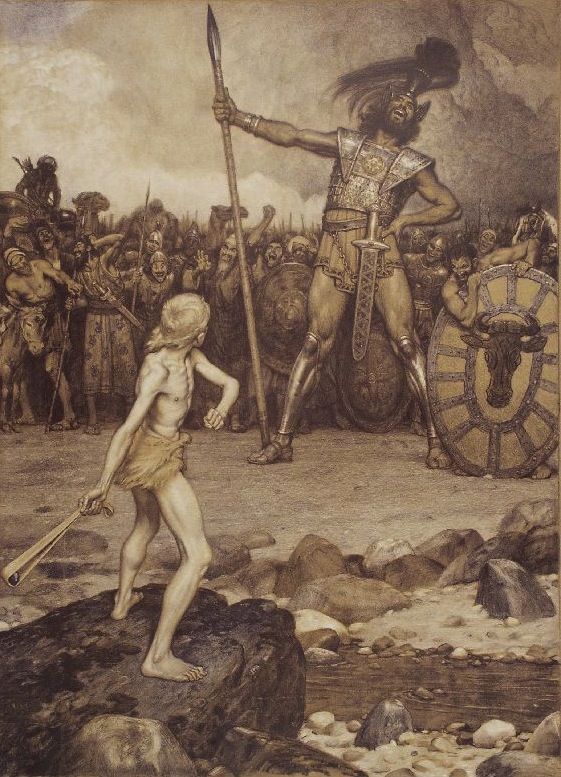
Look at Schindler's picture. Everything the popular reading needs is there: David is small and Goliath is enormous, and the story is about nerve. Now let's read the chapter on all three levels and see how much the picture leaves out.
Before reading on, say who the hero is on the bottom level, the story of the chapter itself, and on the top level, the plan of God. Two names or two phrases. We'll come to the middle level in a moment, and you'll work that one out for yourself.
Show the answer
Bottom level: David, the unlikely shepherd who beats the champion. Top level: God, who rescues his people through the king he chose, so that "all the land will realize that Israel has a God". If you wrote "David" both times, you've read the bottom level twice. Keep going.
Bottom level. A shepherd boy, sent to his brothers with roasted grain and loaves and carrying ten cheeses for their commanding officer, hears a Philistine champion taunt the army of Israel and asks why nobody has answered. His oldest brother is angry with him and accuses him of pride. He is brought to Saul, offered the king's armour, and refuses it. He goes down with a sling and five stones and kills Goliath. On this level the story is about an unlikely hero, and that's real. The chapter is built so that you feel the size of the giant and the smallness of the boy.
Middle level. Now do the next step yourself, before you read my version of it.
Go back to 1 Samuel 8 to 10 and read 8:20, where Israel says what it wants a king for, then 9:2 and 10:23 on Saul's height. Then 1 Samuel 16, verses 1, 7 and 13. Then 17:11. Write one sentence on what the chapter is saying about Saul before David ever arrives.
Show the answer
Israel asked for a king who would "judge us and lead us and fight our battles" (1 Samuel 8:20, NET),3 and got a man who "stood head and shoulders above" everyone in the nation (9:2, NET). Now the tallest man in Israel is "upset and very afraid" of the tallest man in Philistia (17:11, NET). The narrator has already told us, one chapter earlier, that God has rejected Saul as king (16:1) and that "People look on the outward appearance, but the Lord looks at the heart" (16:7, NET). The Spirit has come on David at his anointing (16:13). So when the boy walks into the valley, the chapter is showing Israel who its real king is. The fight in front of you is David against Goliath. The argument underneath it is David against Saul.
Read the armour scene again with that in mind:
"Then Saul clothed David with his own fighting attire and put a bronze helmet on his head. He also put body armor on him. David strapped on his sword over his fighting attire and tried to walk around, but he was not used to them. David said to Saul, 'I can't walk in these things, for I'm not used to them.' So David removed them." (1 Samuel 17:38-39, NET)3
The king's armour is no use to the king God chose. That detail is not there by accident. On the middle level the chapter is a scene in the long story of Israel's kingship: the man of outward appearance failing, the man after God's heart stepping into his place.
Top level. Now read David's speech, which is the longest thing anyone says in the chapter:
"You are coming against me with sword and spear and javelin. But I am coming against you in the name of the Lord of Heaven's Armies, the God of Israel's armies, whom you have defied! This very day the Lord will deliver you into my hand. I will strike you down and cut off your head." (1 Samuel 17:45-46a, NET)3
"Then all the land will realize that Israel has a God, and all this assembly will know that it is not by sword or spear that the Lord saves! For the battle is the Lord's, and he will deliver you into our hand." (1 Samuel 17:46b-47, NET)3
David tells you the point of his own story, inside the story. The battle belongs to God. The purpose of the fight is that "all the land will realize that Israel has a God". The tenth principle isn't a pious gloss we add afterwards, at least not here: the narrator built it into the climax of this chapter, and David says so before he throws.
"Face your giants" doesn't become false. Courage in the face of something too big for you is on the page. But it's the bottom level, and it was never the reason the chapter was written. A reader who stops there makes David the hero of a story in which David explicitly hands the credit to someone else, and then tries to become David.
Gideon's fleece, and the silence that gets read as a yes
The first example was a story most people read on the wrong level. This one is a story most people turn into a method.
Open Judges 6. God has called Gideon to rescue Israel from Midian. Read the call first, because everything depends on it:
"Then the Lord himself turned to him and said, 'You have the strength. Deliver Israel from the power of the Midianites! Have I not sent you?' Gideon said to him, 'But Lord, how can I deliver Israel? Just look! My clan is the weakest in Manasseh, and I am the youngest in my family.' The Lord said to him, 'Ah, but I will be with you! You will strike down the whole Midianite army.'" (Judges 6:14-16, NET)3
That's a direct promise, with a direct commission. Gideon then asks for a sign and gets one, fire from the rock (6:17-24). He tears down his father's altar to Baal at night, because he's afraid of his family and the town (6:27). The Spirit comes on him, he summons an army, and then, with the army gathered and the promise given twice, we get the fleece:
"Gideon said to God, 'If you really intend to use me to deliver Israel, as you promised, then give me a sign as proof. Look, I am putting a wool fleece on the threshing floor. If there is dew only on the fleece, and the ground around it is dry, then I will be sure that you will use me to deliver Israel, as you promised.' The Lord did as he asked. When he got up the next morning, he squeezed the fleece, and enough dew dripped from it to fill a bowl." (Judges 6:36-38, NET)3
Notice the phrase he uses, twice in four lines: "as you promised". Gideon is not asking what God wants. He is asking whether God meant it. Then he asks again:
"Gideon said to God, 'Please do not get angry at me, when I ask for just one more sign. Please allow me one more test with the fleece. This time make only the fleece dry, while the ground around it is covered with dew.' That night God did as he asked. Only the fleece was dry and the ground around it was covered with dew." (Judges 6:39-40, NET)3
Before you read on: what do you expect the story to say about the fleece afterwards? Write down what you expect the narrator, or God, or Gideon, to say, and where in the next chapter you expect to find it.
Show the answer
Nothing, anywhere. The story moves straight on to the army in chapter 7 and never mentions the fleece again. No comment on it, no reference back to it, from anyone. If you predicted a rebuke or a commendation, that is worth sitting with: you expected the text to grade the act, and it didn't, and the reading most people have been given fills that gap with a yes.
"Putting out a fleece" is a phrase Christians use for setting God a test: if the job offer comes by Friday, I'll take it as a yes. The reasoning is that Gideon did it, God answered, and nobody in the text objects. So it must be allowed, maybe even wise.
Now read it by the rules.
Ask what Gideon is actually doing. He's not seeking guidance. He has it, twice, in God's own words: "Have I not sent you?" and "You will strike down the whole Midianite army". And notice his own nervousness in verse 39, "Please do not get angry at me". Gideon knows this is a risky thing to ask. He's a frightened man asking a patient God for reassurance he's already been given.
Fee and Stuart have a name for the mistake the popular reading makes, and it is one of nine they list: misappropriation, using a story for a purpose it was not there to serve.2 Their example is this exact passage. And they go further than a warning about method. They read the chapter as saying that God saved Israel through Gideon despite his lack of trust in God's word, which makes the story an account of God's mercy rather than a technique for finding God's will.2 The BibleProject video above reaches the same verdict.
So I should be straight with you: the textbook this lesson is built on is harder on Gideon than the next paragraph is going to be, and it gets there by a route the ninth principle allows. Principle 9 says a narrative teaches either explicitly or by clearly implying, and Fee and Stuart are reading an implication out of the context: a double promise, a sign already given, and a man asking twice more. That is a real kind of reading, not an invention.
I'd put the line in a slightly different place, and you should know that's a judgement rather than a finding. The narrator writes no verdict on the fleece, and the two readings people bring to that silence pull in opposite directions. Some read it as approval, so fleeces are fine. Others read it as condemnation, so Gideon was faithless. The first has nothing at all to work with. The second has a good deal: the context Fee and Stuart point to, and the fact that two chapters later the narrator does step forward about Gideon, when he makes an ephod and "It became a snare to Gideon and his family" (Judges 8:27, NET).3 Barry Webb, Daniel Block and others read the whole Gideon cycle as a sustained critique on those grounds, and several of them are conservative evangelical commentators, so this is not a sceptic's reading.
What I want you to take from it is narrower than either verdict, and it is a habit rather than an answer. The fleece itself is never approved, condemned, or mentioned again. Gideon is judged later, and about something else. If you want to argue from chapter 8 back to chapter 6, you are inferring from the shape of the whole story, which is legitimate, and you should say that is what you are doing rather than claim chapter 6 condemns him. Meanwhile the story itself shows God's patience: in chapter 7 God gives Gideon a sign he never asked for, sending him down to the enemy camp to overhear a dream (7:9-15).
So may a Christian ask God for a sign? That's a question the story doesn't settle, and I won't pretend it does. What the story does settle is that Gideon is not a model for how to get guidance you don't yet have. He's a picture of a man who already had it and struggled to trust it, and of a God who bore with him. That is a story worth having, and it's a different story from the one on the bookmark.
None of that is a sneer at the bookmark. People reach for these lines because they want God to say something to them personally, which is the right instinct. The point is that the story will give them more than the line does, not less.
In one sentence each: what does Judges 6:36-40 describe, and what does it prescribe?
Show the answer
It describes a frightened man asking God twice to confirm a promise God had already made, and God granting both requests without comment. It prescribes nothing. The passage contains no command and no evaluation, and any judgement about the practice has to come from elsewhere in Scripture, which is where principle 6 and Duvall and Hays's fourth step both send you. If you went looking, Deuteronomy 6:16 forbids putting the Lord to the test, and Jesus quotes it to Satan in Matthew 4:7. Whether Gideon's request falls under that is exactly the judgement the chapter leaves you to make.
What people get wrong
"A literal reading is the faithful reading." This is the biggest one, and it's held by people on both sides of the argument: some who think they're being faithful by ignoring genre, and some who think genre-first reading is a liberal invention. Neither is right. The Chicago Statement on Biblical Inerrancy (1978), drafted by nearly three hundred evangelical leaders as the reference statement of that doctrine, affirms in Article XVIII that the text is to be interpreted "taking account of its literary forms and devices", and its exposition says outright: "So history must be treated as history, poetry as poetry, hyperbole and metaphor as hyperbole and metaphor, generalization and approximation as what they are, and so forth."4 Reading a text by its genre is what that statement requires. Asking whether a passage is literal is the wrong first question; ask what kind of writing it is, and the answer tells you what "literal" would even mean here.
There is a limit on that which belongs in the same paragraph, in fairness to the people who signed it. The same movement's follow-up, the 1982 Chicago Statement on Biblical Hermeneutics, denies in its Article XXII that "generic categories which negate historicity may rightly be imposed on biblical narratives which present themselves as factual", and the 1978 statement's Article XII denies that scientific reconstructions of earth history may be used to overturn what Scripture teaches about creation and the flood.4 So Chicago is not a licence to reclassify whatever you find awkward. Its point, and ours, is narrower: work out what kind of writing a passage is from the text's own signals, then hold it true as that kind.
"Everyone in the story is a role model." Principle 4: frequently the opposite. Abraham lies about his wife, twice. Jacob cheats his brother and his father. David commits adultery and murder. Samson breaks every vow he's under. The stories don't hide any of this, and they rarely stop to say "don't do this". They expect you to know.
"If the Bible records it, the Bible recommends it." This is the Gideon error in general form, and it turns up all over: polygamy in Genesis, casting lots in Acts, Jephthah's vow. Fee and Stuart list nine standard misreadings of narrative, and this one has two of the nine to itself: misappropriation, using a story for a purpose it wasn't there to serve, and false appropriation, drawing from a story an idea it doesn't support. The other seven are allegorising (looking past the plain sense for the real one), decontextualising (ignoring the setting), selectivity (picking the details that suit you and dropping the rest), moralising (assuming every story has a lesson to lift), personalising (reading the story as if it were written about you), false combination (welding together elements from different parts of a story), and redefining (making a text mean something else once its plain sense disappoints you).2 The test is simple: is there a command anywhere, or a verdict from the narrator? If not, you're reading a report.
A word of care about the first of those nine, because it is an evangelical textbook's list and it names something other Christians do on purpose. Reading a story for a meaning beyond the plain one is the church fathers' own method. Origen, Gregory of Nyssa and Augustine read this way; John Cassian's four senses, what happened, what it points to in Christ, what it asks of you, and where it all ends, organised a thousand years of Christian reading; the Catechism of the Catholic Church still teaches those four senses at paragraphs 115 to 118, and Orthodox reading in the liturgy is soaked in them. So when Fee and Stuart call allegorising an error, they are not describing something only careless readers do. What they object to, and what this course objects to with them, is allegory that replaces the plain sense instead of resting on it, and that can be made to mean anything because nothing constrains it. The fathers said the same: the literal sense comes first. Our rule is theirs, narrowed. Get what the text says before you ask what it points to, and let the rest of Scripture, rather than your ingenuity, tell you what it points to. Where we differ from a Catholic or Orthodox reader is in how much weight the further senses carry and who is entitled to find them, and that is a difference inside the church, not a difference between reading well and reading badly. The same goes for moralising, which is Cassian's third sense under a less friendly name.
"The story is about me." This is personalising, and it is the most common misreading of biblical narrative in the English-speaking church, so it deserves its own line rather than a mention in a list. It is where this lesson started: name the Goliath in your life. The move is to read yourself into a character's slot and take the story as instructions for your week. It feels like taking the Bible seriously, which is why it is hard to shift. The test is the basic rule again. Could the first readers have heard "you are David"? They could not. They were being told who their king was.
"If God blessed them, he approved of what they did." Outcome read as verdict. This is a stronger claim than the one above, because it does not just fail to find a verdict, it manufactures a positive one, and it is the specific error the fleece story is good for. God answered Gideon, so the fleece must be fine. God prospered Abram in Egypt, so the lie must have been fine. God gave Jacob the birthright, so the deception must have been fine. In each case God is keeping a promise he made, and the promise was not conditional on the method. Watch for this one in yourself; it is the most comfortable of all the misreadings, because it turns every good outcome in your own life into divine approval of how you got it.
"Genesis 1 must be read as one particular genre." You'll hear that Genesis 1 is obviously plain history, and you'll hear that it's obviously a poem. Both statements skip the question this lesson is about. Christians who hold the chapter to be entirely true, and who hold to the Chicago Statement, read its genre differently: as a straightforward chronological account, as a structured literary account of a real creation, as a temple text, and in other ways. That is the argument among Christians who hold the chapter true, and it is worth saying what lies outside it. Critical scholars read Genesis 1 as a priestly text from around the exile, written in deliberate contrast to the Babylonian creation story Enuma Elish, which shares parts of its sequence and none of its theology. Jewish commentators from Rashi onward have read the opening line as a dependent clause, "When God began to create", which is how the Jewish Publication Society translates it and which changes what the first sentence claims before anyone reaches the six days. This course points you to Faith and Science for all of it. All we say here is that the genre question comes first, and that saying "literal" does not settle it.
Where the course stands
Three kinds of claim run through this lesson, and it is worth separating them.
Scholars establish that Hebrew narrative is spare. It explains its characters far less than a modern novel does, and it comments in its own voice far less often. That much nobody disputes, and it is the observation everything in this lesson rests on.
Scholars argue about how much that silence is doing, and this course has taken a side without saying so until now. Robert Alter reads the reticence as a technique, so that repeated words and small details carry the judgement the narrator declines to state.10 Meir Sternberg goes further and reads the narrator as evaluating almost everywhere, just never in the flat way we expect. This course has taught the cautious version, that an explicit verdict is rare and you should not invent one, and you should know that a serious reader can find a good deal more evaluation in these chapters than we have. Alter is worth reading partly because he'll show you how much can be heard in a silence. His own description of the David narratives, for the record, is "historicized prose fiction", which is not our view of them, and it is one of the reasons his book is worth arguing with rather than simply agreeing with.
Scholars also argue about how these books reached us, and we chose the hardest chapter in Samuel for our worked example, so here is what that costs. The oldest Greek manuscripts carry a version of 1 Samuel 17 to 18 about half the length of the Hebrew, missing among other things the passage where David arrives with the bread; and in the Hebrew, Saul asks whose son the boy is at 17:55-58, one chapter after David has been playing the lyre for him and serving as his armour-bearer at 16:21-23. There is also 2 Samuel 21:19, where a man called Elhanan kills Goliath. Your NET reads "the brother of Goliath" there, following 1 Chronicles 20:5, and that supplied phrase is a translation decision you should know about rather than discover later. Critical scholars read all of this as two accounts joined together; conservative scholars read the Greek as an abridgement and take the Chronicler's wording as original. We hold the second. The reading rules in this lesson do not change either way, but the confidence with which I said "the narrator set this up" does, because it assumes one designing mind behind chapters 16 and 17.
One more thing argued, since the Go deeper list uses the phrase. Critical scholars from Martin Noth onward argue that Deuteronomy, Joshua, Judges, Samuel and Kings were shaped into one long work by an editor or editors during the exile, looking back and asking how it all went wrong. They call it the Deuteronomistic History, and the refrain I used to read Jephthah, that there was no king in Israel in those days, is one of their main exhibits: they read it as a later editor's frame rather than the storyteller's own line. Conservative scholars accept that these books were edited and collected and dispute that a single exilic theologian reshaped them to a thesis. This lesson has written "the narrator of Judges" throughout, which assumes the second. If the first is right, the evaluations still sit where they sit and you would attribute them to an editor instead. Lesson 10 takes the argument up properly, along with the historicity questions: what the Tel Dan stele does and does not show about David, and the live disputes over the scale of the exodus, the conquest, and the united monarchy.
We hold by faith that God is the hero of all these stories, and this is where our commitment is loudest, so let me be exact. That 1 Samuel 17 puts God at the centre is on the page. David says it himself, in the longest speech in the chapter, and a reader of any conviction can see it. That the same is true of every biblical narrative is not something the texts can be made to show, and Esther, which never names God, is the case that proves it. "God is the hero of all biblical narratives" is a confession about the whole book, held by faith, and then applied as a reading rule. We hold it and we use it. It is not a finding about Hebrew literature, and you should be able to tell the difference.
A Jewish reader reads 1 Samuel 17 in the Tanakh, where it sits among the Former Prophets, the Nevi'im Rishonim, alongside Joshua, Judges and Kings, and where these books are read as prophecy and not only as history. Much of what this lesson says about the bottom and middle levels a Jewish reader would say too, and Jewish commentary on this chapter, through the midrash and Rashi and Radak, has been reading its details closely for a very long time. Here is the verse this lesson opened with in the Jewish Publication Society's 1917 translation, which is closer to what a Jewish reader is likely to have in front of them:
"and that all this assembly may know that the LORD saveth not with sword and spear; for the battle is the LORD'S, and He will give you into our hand." (1 Samuel 17:47, JPS 1917)12
Same claim, older English, and nothing in the reading we did depends on which of the two you use. The three-level scheme itself, though, is ours and not a neutral description. A top level running from creation to new creation with Christ at its centre is a Christian shape, and a Jewish reader does not read the Tanakh as a book missing its last act. They read it as complete. This course holds the Christian reading and says so on its first line. It doesn't think saying so has proved it.
Now do it yourself, on Jacob and Esau
Read Genesis 25:19-34 and Genesis 27. About fifteen minutes.
- Write the story in three lines, one for each level. Bottom level: what happens between two brothers and their parents. Middle level: what this means for the line of Abraham and the promise. Top level: what God is doing. You'll have to find the top level yourself this time; look for where God speaks or is spoken about, and place the episode on lesson 2's six acts.
- Go through both passages and mark two things, keeping the narrator's own voice separate from the characters'. Put a tick beside every sentence where the narrator, or God, evaluates a character or an action. Put a dash beside every sentence that merely reports. Characters saying what they think of each other, and there is plenty of that in chapter 27, counts as report: the narrator is reporting that they said it. Count both.
- Now write a paragraph on what a reader gets wrong by treating Jacob as a model. Be specific: name the act they'd end up copying, and say which principle stops them.
- Mixed set, one line each, and don't do them in order. For each of these, say which of the nine misreadings it is: (a) a sermon that says Rebekah shows how a mother should fight for her son's future; (b) a study guide that says the two goatskins on Jacob's arms stand for the two natures of Christ; (c) a devotional that says God blessed Jacob afterwards, so the deception must have been acceptable in the circumstances; (d) a talk on Genesis 27 that never mentions the oracle in 25:23.
- The hard one. God's promise in 25:23 comes true through Jacob's deception. Does the story therefore approve the deception? Answer in two sentences, using principle 6, and say where else in Scripture you would look for the verdict.
Exercise parts 1 and 2: check your levels and your count before you go on.
Show the answer
Part 1, a model set. Bottom: a younger twin buys a birthright from a hungry brother, then takes the blessing by dressing as him, and has to run for his life. Middle: the promise made to Abraham passes to the younger son rather than the elder, against every convention of inheritance, and the family that carries it is a mess of favouritism on both sides. Top: God said before either boy was born that "the older will serve the younger" (Genesis 25:23, NET), and act 3 of the story keeps going through people who behave like this rather than around them.
Part 2. The dashes will outnumber the ticks by a very large margin, and you may find you cannot locate a single clear tick in either passage. That is the finding. Genesis 27 in particular is full of people evaluating each other, and none of it is the narrator: Isaac says "Your brother came in here deceitfully and took away your blessing" and Esau says "Jacob is the right name for him! He has tripped me up two times" (Genesis 27:35-36, NET), but those are characters speaking, and the narrator is reporting that they spoke. If you counted those as ticks, go back and re-sort. The gap between a character's verdict and the narrator's is the whole skill this exercise is training.
Exercise part 4: the mixed set.
Show the answer
(a) Moralising, and personalising close behind it: a lesson is lifted from a report, and the reader is invited into Rebekah's slot. (b) Allegorising. The goatskins are in the story because Jacob needed to feel hairy. Note the care we owe this one: reading for a further sense is the fathers' method, and the objection here is that nothing in the text or the rest of Scripture constrains this particular reading, so it could be made to mean anything. (c) Outcome read as verdict, which is Fee and Stuart's false appropriation: an idea is drawn from the story that the story does not support. (d) Decontextualising, and selectivity: the one place God speaks in the whole episode has been dropped, and 25:23 is what makes chapter 27 more than a family quarrel.
Exercise part 5: the hard question.
Show the answer
No, and principle 6 is why. The chapter reports that the promise arrived through a deception; it does not tell you at the end whether the deception was good or bad, so the verdict has to come from what God has taught plainly elsewhere. Look at the ninth commandment, at the law on false witness, and at the rest of Jacob's own story, where Laban deceives him with a substituted bride in almost exactly the pattern he used on his father, and where he limps out of the encounter at the Jabbok. The pattern to take away is the one this lesson keeps returning to: God keeping a promise is not God endorsing the method somebody used to secure it. If you want the stronger claim, that the story quietly disapproves, you can argue it from the shape of Jacob's life the way the commentators argue about Gideon, and you should say that is what you're doing.
When you're done, close the page and, on paper, write out the basic rule from memory, the three levels, and as many of the ten principles as you can. Then check. Rereading the list will feel like it worked and won't do much; writing it from memory is the part that lasts.
Connections
Lesson 2 gave you the top level of narrative as a map of the whole Bible. This lesson has taken one chapter and read it on all three levels at once, which is what the map is for. Lesson 1's warning about chapter divisions is worth remembering too: 1 Samuel 17 only makes full sense with chapter 16 read first, because the narrator set up Saul's rejection and David's anointing before the giant ever appeared.
Every lesson from here to lesson 7 uses the method you've just learned: identify the kind of writing, learn its rules, then read. Lesson 4 turns to law and prophecy, where the rules are very different, and where the basic rule does even harder work. Lesson 6 applies today's principles to the Gospels and Acts. The temptation to turn description into prescription is strongest there, because what's being described is the early church.
Go deeper
- Fee and Stuart, How to Read the Bible for All Its Worth, 4th ed., chapter 5, "The Old Testament Narratives: Their Proper Use". The full statement of the ten principles and the nine errors, with their own worked examples, including Ruth and Joseph, and their reading of the fleece, which is firmer than mine. About twenty pages.2
- Robert Alter, The Art of Biblical Narrative, revised edition (Basic Books, 2011). The book that taught many readers to see how Hebrew narrative works: the narrator's reticence, the meaning carried by repeated words, the type scene. Written by a Jewish literary scholar; you'll disagree with him in places and read the stories better for it. His own translation, The David Story (1999), covers Samuel, and reading his 1 Samuel 17 beside the NET is the fastest way to see that translation is interpretation.10
- Longman and Dillard, An Introduction to the Old Testament, 2nd ed. (Zondervan, 2006). This lesson sends you into 1 Samuel, Judges and Genesis without telling you how to get your bearings in a book you have never read. This is the standard evangelical answer: historical background, literary analysis, and theological message, one chapter per book. Read its chapter before you read the book.
- BibleProject, "Character in Biblical Narrative" and "Setting in Biblical Narrative". The two companion videos to the plot video above, each about five minutes, on why the Bible's characters are so rarely explained and why place names carry weight.8
- Christine Hayes, Yale RLST 145, lecture 12 (Joshua and Judges, which is Gideon and Jephthah) and lecture 13 (1 and 2 Samuel, which is our chapter). The same books read by the historical-critical method rather than from a confession, by a scholar who taught them at Yale for three decades. These are the lectures where you will meet the Deuteronomistic History as an argument rather than a label. Free video and transcripts.11
- The Jewish Study Bible, 2nd ed. (JPS Tanakh, OUP 2014). If you want the Former Prophets read from inside the tradition that has read them longest, this is the one volume to have. It is the set text for the Yale course above.
Sources
- Fee, G. D. & Stuart, D., How to Read the Bible for All Its Worth, 4th ed. (Zondervan, 2014), chs. 1, 4, and 5. The basic rule, "a text cannot mean what it never could have meant to its author or readers" (ch. 4, restating ch. 1 in slightly different words); the figures "over 40 percent of the Old Testament is narrative" and the Old Testament is "three-quarters of the bulk of the Bible" (ch. 5); the three levels of narrative. The three-step order given at the top of this lesson (what kind of writing, its rules, then read) is this course's summary of how the book works, not a formula quoted from it.
- Fee & Stuart, ch. 5, "The Old Testament Narratives: Their Proper Use". The ten principles for interpreting narratives, ending "In the final analysis, God is the hero of all biblical narratives"; the nine errors in reading narrative (allegorizing, decontextualizing, selectivity, moralizing, personalizing, misappropriation, false appropriation, false combination, redefining), the Gideon fleece given as their worked example of misappropriation, and their reading that God delivered Israel through Gideon despite his lack of trust.
- NET Bible, netbible.org. Quoted as printed: Psalm 114:4; 1 Samuel 8:20; 9:2; 16:7; 17:11; 17:38; 17:38-39; 17:45-47; 2 Samuel 11:27; Judges 6:14-16; 6:36-40; 8:27; 17:6; 21:25; John 21:25; Genesis 25:23; 27:35-36; Esther 4:14 (quiz question 4); 2 Samuel 6:7 and 1 Chronicles 15:13 (quiz question 6, referred to rather than quoted). Scripture quoted by permission. Quotations designated (NET) are from the NET Bible® copyright ©1996, 2019 by Biblical Studies Press, L.L.C. All rights reserved. Other passages (1 Samuel 10:23; 16:1; 16:13; 16:21-23; 17:55-58; Judges 6:17-24; 6:27; 7:9-15; 11:30-39; Deuteronomy 6:16; 12:31; 18:10; Matthew 4:7; Joshua 10:12-14; 2 Samuel 1:18; 21:19; Genesis 12:10-20; 20; 26; Philippians 4:11-13; Jeremiah 29:11) are referred to or summarised.
- The Chicago Statement on Biblical Inerrancy (International Council on Biblical Inerrancy, 1978), and the Chicago Statement on Biblical Hermeneutics (1982). From 1978: Article XIII (inerrancy not negated by "the reporting of falsehoods, the use of hyperbole and round numbers, the topical arrangement of materials, variant selections of material in parallel accounts"); Article XII (denying that scientific hypotheses about earth history may be used to overturn Scripture on creation and the flood); Article XVIII ("the text of Scripture is to be interpreted by grammatico-historical exegesis, taking account of its literary forms and devices"); and the Exposition, "So history must be treated as history, poetry as poetry, hyperbole and metaphor as hyperbole and metaphor, generalization and approximation as what they are, and so forth." From 1982: Article XXII, denying that "generic categories which negate historicity may rightly be imposed on biblical narratives which present themselves as factual". Read from the 1978 text with exposition; the ETS archive URL used at Stage 1 now returns 404.
- Duvall, J. S. & Hays, J. D., Grasping God's Word, 4th ed. (Zondervan, 2020). The five-step Interpretive Journey: grasp the text in their town, measure the width of the river, cross the principlising bridge, consult the biblical map, grasp the text in our town.
- Osborne, G. R., The Hermeneutical Spiral, 2nd ed. (IVP Academic, 2006). Interpretation as a spiral between the text's horizon and the reader's; the three stages, what it meant, what it means for me, how to share it.
- Vanhoozer, K. J., Is There a Meaning in This Text? (Zondervan, 1998). Meaning as the author's communicative action; a defence of recoverable authorial meaning, written against Gadamer, Ricoeur, Derrida and reader-response criticism, which is why the position is given here as argued rather than settled. For the Catholic qualification, Dei Verbum 12 (1965).
- BibleProject, "Literary Styles in the Bible" (2017, 5:28; on YouTube under the title "Writing Styles of the Bible & Why They're Important to Understand", youtube.com/watch?v=oUXJ8Owes8E) and "Plot in Biblical Narrative" (2017, 5:13, youtube.com/watch?v=dLFCE8z__hw). Both verified as BibleProject uploads via the YouTube oEmbed endpoint, titles, authorship and running times confirmed. The Plot video works through Judges 6 to 8 and reads Gideon's fleece as distrust.
- Schindler, O., David und Goliath (1888), lithograph, 78 x 58 cm. Wikimedia Commons, File:Osmar_Schindler_David_und_Goliath.jpg. Public domain (artist died 1927). Commons describes it as a colour lithograph; the print is close to monochrome sepia, which the alt text reflects.
- Alter, R., The Art of Biblical Narrative, revised ed. (Basic Books, 2011; first ed. 1981). Narrative reticence, repeated key words, type scenes; the description of the David narratives as "historicized prose fiction". The David Story: A Translation with Commentary on 1 and 2 Samuel (Norton, 1999). Meir Sternberg, The Poetics of Biblical Narrative (Indiana University Press, 1985), is named in the text as the counter-position on how much the biblical narrator evaluates.
- Hayes, C., Introduction to the Old Testament (Hebrew Bible), Yale Open Courses RLST 145 (Fall 2006), lecture 1 for the "library" description and lectures 12 to 14 on the Deuteronomistic History. Free video and transcripts at oyc.yale.edu. Hayes retired in 2023 and is Sterling Professor Emerita, so this course writes "who taught". Martin Noth's 1943 study is where the Deuteronomistic History hypothesis begins.
- The Holy Scriptures: A New Translation (Jewish Publication Society, 1917), 1 Samuel 17:47, read from Sefaria. Public domain. Used here because the sentence is being offered as what a Jewish reader has in front of them, per Editorial Standards 4.7.
Check your understanding
This lesson has a 6-question quiz. Pass it and the questions come back on a schedule in Review, so what you learned stays learned. Your progress is saved in your browser; no account needed.