Pests: find the cause, then control it
100 min
Two hosts talk the lesson through. The voices are synthetic; the script was written from this lesson and checked against it, and asserts nothing the lesson does not.
- Apply integrated pest management's steps (threshold, identify, prevent, then control) to a described pest problem, and say which step a proposed action skips
- Deal with mice or rats in CDC's steps (seal up, trap up, clean up), with its clean-up precautions, and state, as general information, what the label and the regulators in each country say about who may use which rodent poisons
- State which UK nations' laws cover glue traps and what each makes an offence, and explain, from the two 2019 studies, why foggers fail against German cockroaches and what works instead
- Identify the signs of bed bugs, clothes moths, woodworm and (in the US) termites, and decide which is yours to deal with and which needs a professional
A mouse in the kitchen, a cockroach under the sink, holes in a floorboard: the first thing many people reach for is a can of something, and the regulators and researchers this lesson read put that last, or rule it out. Pests come for food, water and shelter, and they get in through gaps. So the approach the regulators and extension services describe starts with the cause, not the poison. This lesson teaches that approach, then applies it to mice and rats, cockroaches, bed bugs, clothes moths, woodworm and, in the US, termites, with the law on poisons and glue traps set out nation by nation.
This course is education, not a trade qualification, and not legal advice about your own home. It teaches no gas work and no wiring. If you smell gas in Great Britain, open doors and windows, turn the gas off at the meter if you can do it safely (not if the meter is in a cellar or basement), and call 0800 111 999; in Northern Ireland the number is 0800 002 001. In the US, leave straight away and call 911 or your gas utility once you're outside. In either country, don't light a flame or touch an electrical switch. Isolate the water or power before you open anything up, and if a breaker, RCD or GFCI keeps tripping, leave it off and call an electrician. Which jobs the law leaves to a registered or licensed trade differs between England, Wales, Scotland, Northern Ireland and each US state, and it changes.
Pest work takes you to where pipes and cables come into a house, because that's where the gaps are. This course's line: note those gaps, and don't fill or pack round a gas pipe, a meter or a cable yourself; ask the landlord, a qualified gas engineer (Gas Safe registered, in the UK) or an electrician. The box stays shut too, as lessons 5 and 6 said: CPSC, the US Consumer Product Safety Commission, says panel boxes "are usually electrically live, even with the main circuit breakers turned off",23 and HSE's guidance for people who work on electrical systems does not recommend "non-contact devices such as 'volt sticks'" for proving anything dead.24
Two sections of this lesson state law: the one on poisons and the one on glue traps. This is general information, not legal advice. The rules differ between England, Wales, Scotland and Northern Ireland, and between US states and cities, and they change.
Some pests are left out on purpose: this course read no official source on wasp nests, ants, flies, fleas or silverfish, so it says nothing about them.
Find the cause first: integrated pest management
The US Environmental Protection Agency (EPA) calls the approach integrated pest management, or IPM. Its page is written mainly for growers, but it says IPM "can be applied to both agricultural and non-agricultural settings, such as the home, garden, and workplace".1 It has four steps:1
- Set a threshold. Decide what level of problem calls for action. "Sighting a single pest does not always mean control is needed."
- Monitor and identify. Find out what the pest actually is, so you don't treat the wrong thing or treat when there's nothing to treat.
- Prevent. Manage the space so pests don't become a problem in the first place.
- Control, and only when the first three say so. "Effective, less risky pest controls are chosen first", such as traps. "Broadcast spraying of non-specific pesticides is a last resort."
EPA writes the threshold about pests as an "economic threat" to crops, so using it in a house is this course's reading: one mouse is a reason to find its way in, not yet a reason for poison.
Great Britain's regulator starts from the same place. The Health and Safety Executive (HSE), in its guidance on using biocides at home and at work, says "Everyone who uses biocides is responsible for using them correctly", and before you buy one, asks "Is there a problem that needs to be controlled?" and whether there's an alternative: traps, sealing doors and windows, storing things differently, and keeping the area "clean, dry and well maintained".2 (HSE's pages use "biocide" for products such as rodent poisons; the label examples it gives include products for use against ants, woodlice and cockroaches.)
A kitchen has had a few cockroaches and one mouse in a month. Before reading on: of IPM's four steps, which does reaching straight for a spray skip, and why might that matter more than the spray itself?
Show the answer
It skips the first three. There's no threshold (is this a problem yet?), no identification (a spray chosen for cockroaches does nothing about a mouse), and no prevention (the gap under the back door and the open packet in the cupboard are still there). EPA's order puts control last, and even then chooses "less risky" controls first.1 A spray that kills today's cockroaches leaves tomorrow's the same way in.
Mice and rats: seal up, trap up, clean up
The Centers for Disease Control and Prevention (CDC), the US public health agency, puts rodent control in three steps, seal up, trap up and clean up, and its trapping page puts sealing first.3456 It lists the diseases rodents can spread, with hantavirus among them, and its clean-up rules are built round breathing them in; this course read nothing on hantavirus in the UK. Applying CDC's steps and clean-up anywhere is this course's reading, not a UK body's advice.
The signs
CDC names two: droppings and gnaw marks. "Rodent droppings are pointed at one end and often contain hair." They turn up in cupboards, drawers and places out of sight. Old droppings don't prove mice are still there, so CDC's test is to clean the area safely and look again: "If droppings are present after cleaning, this indicates an active rodent presence."3

_droppings_with_10_and_20_euro_cent_coins_and_a_ruler,_Utrecht,_The_Netherlands,_December_14,_2019.jpg)
Seal up
"Mice can fit through a hole the width of a pencil (1/4 inch or 6 millimeters in diameter)."4 CDC's list of places to look runs from under and behind kitchen units and appliances to the pipes under sinks, cupboard corners and where floor meets wall; outside, doors, windows, eaves, vents and the foot of the walls. Its fixes: steel wool held in with caulk (sealant) or spray foam for small holes, and metal sheeting, wire mesh or cement for larger ones. Food goes in sealed containers.4
CDC's list includes holes round electrical, water, gas and sewer lines.4 Look there, but by this course's line above, a gap round a gas pipe, a meter or a cable goes to the landlord or the right trade. Sealing ordinary small gaps is Yours, if it's your home to repair or your landlord agrees.
Trap up
CDC: "Traditional snap traps are recommended to reduce rodent populations around the home. Only use poison or bait stations for mouse and rat infestations that persist."5 And a warning with its reason: "Do not use glue traps and live traps. These traps can scare the rodents, causing them to urinate, which can increase your chance of getting sick." Its method:5
- Set a lightly baited trap on the floor with the baited end against the wall, so it makes a T. "Rodents prefer to run next to walls or other objects for safety."
- Put traps where you've seen signs, and in closed places: behind the cooker and fridge, at the back of cupboards. Check them daily, out of reach of children and pets.
- Rats are wary of anything new, so pre-bait: bait the traps unset until the bait is being taken.
- CDC's all-clear: "If no rodents are captured for a week and there are no new signs of rodents, the rats are gone."
Setting snap traps this way is Yours, by CDC's advice and the trap's own instructions.
Clean up
This is where most people get it wrong, because the natural thing is to sweep. CDC: "Don't vacuum or sweep rodent urine, droppings, or nesting materials." Its reason: it "can cause tiny droplets containing viruses to get into the air". Its steps for a home:6
- Air it. "Open all doors and windows for 30 minutes before cleaning to ventilate the space. Leave the area during this time."
- Gloves. Rubber or plastic.
- Soak. Spray the droppings and urine with a household disinfectant, or a bleach solution, "1 part bleach to 9 parts water", until very wet. "Let it soak for 5 minutes or according to instructions on the disinfectant label."
- Wipe with paper towels into a covered bin (trash can), then disinfect the surfaces round it.
- Dead mice and nests: spray, soak, and bag twice, each bag knotted.
- Wash gloved hands, take the gloves off, and wash your hands.
A small clean-up this way is Yours, on conditions: CDC's precautions, every time. CDC says "Additional precautions should be used for cleaning homes or buildings with heavy rodent infestation", and sends rodents in heating and cooling ducts, or in places you can't reach to clean, to a professional.64 Those are Call someone.
Poisons: the label, and who may use what
This section states law. This is general information, not legal advice.
In the US
EPA says every pesticide label carries the statement "It is a violation of Federal law to use this product in a manner inconsistent with its labeling." "In other words, the label is the law." EPA says the label sets out conditions that "define who may use a pesticide, as well as where, how, how much, and how often it may be used".8
For rodent poisons, EPA's restrictions page says the consumer products are "ready-to-use bait stations" with bait in block or paste form, and "Pelleted baits no longer are permitted to be used in rodenticide products targeted for consumer markets." The second-generation anticoagulants "no longer are registered for use in products geared toward consumers", because they stay in animal tissues longer and pose greater risks to other animals; they're for professional pest control. A consumer station is labelled for indoors, or for indoors and outdoors within 50 feet of buildings, depending on whether it has been shown to resist tampering by young children and by dogs, so EPA says to read the label before you buy.7
In Great Britain and Northern Ireland
Rodent poisons come under the GB Biocidal Products Regulation in Great Britain and the EU's in Northern Ireland, HSE's page says. On the commonest kind, HSE says anticoagulants "present a higher risk to people and non-target animals than is normally acceptable for authorisation in Great Britain and Northern Ireland", and are authorised only because the harm to society of not allowing them would outweigh that, with strict controls. HSE's advice is to "consider other available control methods, such as those listed above, before reaching for anticoagulant products". Products for the public may be restricted in strength, in pack size, and in where they can be used, for example "only within a bait box".9
On who may use what, HSE's biocides guidance says the label tells you who is allowed to use the product: the general public, professional users, or professionals with demonstrated competence. "Members of the general public should never use biocidal products that are only intended for professional users", because professionals must have had training, and some need certification. For a product meant for the public, "Following the label instructions carefully should be enough to allow the product to be used safely and effectively." And a product authorised for one purpose: "the biocide must not be used for any other purpose".2
The law, the advice and the label together
In both countries, then, the label is the rule you meet. The advice sits on top of it: CDC says poison only for infestations that persist after trapping, and HSE says consider other methods before anticoagulants.59
A consumer bait station used by its label, after trapping has failed, is Yours, on conditions: the label's, and CDC's steps. A product marked for professionals is another matter: in the US its label says who may use it and the label is the law, and in Great Britain and Northern Ireland HSE says the public must never use one. A rodent problem that needs one is Call someone. This course's exercises never have you set poison. If a child may have eaten bait, First Aid and CPR lesson 14, "Seizures, low blood sugar and poisoning", has the response and each country's number.
Glue traps: the law in each nation
This section states law. This is general information, not legal advice.
Three UK nations have legislated, differently; this course read the Acts on legislation.gov.uk:
| Where | The law read | What it makes an offence | In force |
|---|---|---|---|
| England | Glue Traps (Offences) Act 2022, section 1 | Setting a glue trap in England to catch a rodent, or in a way that risks catching one; a licence can allow a pest controller | 31 July 2024 |
| Wales | Agriculture (Wales) Act 2023, section 46, amending the Wildlife and Countryside Act 1981 | Setting in Wales a glue trap likely to catch any animal, or using one to kill or take any animal ("animal" meaning a vertebrate); no licence route | 17 October 2023 |
| Scotland | Wildlife Management and Muirburn (Scotland) Act 2024, sections 1 to 3 | Using, supplying or possessing a glue trap without reasonable excuse, unless authorised | 1 July 2026 |
| Northern Ireland | Not read | This course read no Northern Ireland law on glue traps |
- England. "A person who sets a glue trap in England for the purpose of catching a rodent commits an offence." So does someone who finds a set trap that risks catching one and, without reasonable excuse, leaves it that way. Licences go only to pest controllers, "for the purpose of preserving public health or public safety", and only if there is "no other satisfactory solution". The Act extends to England and Wales, but its offences are about traps set in England.
- Wales. Wider than England's: any vertebrate, not only rodents. And no licence: the same Act left the new glue-trap offences out of the 1981 Act's licensing power (section 48).
- Scotland. The widest: possession and supply are offences too, and authorisation, under a scheme the course did not read, is only for protecting public health where "no other method of rodent control is practicable".
- The US. This course read no US law on glue traps, only CDC's advice against them.5
One wrinkle. UC's monitoring tools are "Sticky traps or glue boards", and the NHM's moth traps are "adhesive boxes".1319 England's and Scotland's Acts define a glue trap as one "capable of being used" to catch a rodent, or any vertebrate, and Wales's offence turns on where one is set to catch a vertebrate.101112 Whether a small insect trap falls inside them, this course can't say from what it read; its line, in all three nations, is to ask your council first.
Whether glue traps are humane is a value question. This course read no statement of the case for them, or of the welfare case against them, in their holders' own words, so it reports the laws and CDC's health reason and stops there.
Before the next section: in a study of infested homes, cockroach foggers ("bug bombs") were compared with gel baits costing about the same. What do you expect the foggers did to the cockroach numbers, and what do you expect they left behind in the kitchens?
Show the answer
In 20 homes the foggers didn't reduce the cockroach populations; the gel baits, in 10 homes, did, significantly. And after the foggers went off, pesticide residues on kitchen surfaces averaged 603 times the level before, with a median of 85 times.14 If you guessed "fewer cockroaches for a while", that's the intuition the next section takes apart.
Cockroaches: why the bomb fails
The University of California Statewide IPM Program's guide, written for California homes, puts the whole approach in two sentences: "Good sanitation and exclusion are important for effective control; pesticides alone will not solve cockroach problems. When using insecticides, baits provide better control than sprays."13 UC calls the German cockroach "the most common indoor species in California", living near food and water in kitchens and bathrooms, and "Adult German cockroaches can hide in a crack 1/16 inch wide" (under 2 mm).13 They matter for health: UC says indoor infestations are "important sources of allergens and have been identified as risk factors for development of asthma in children, especially within multi-unit housing environments."13
The two studies
Z. C. DeVries and colleagues at North Carolina State University published two studies in 2019. This course read the abstracts only. The first tested total release foggers, the "bug bombs" sold in shops, in 20 infested homes, five for each of four products, against gel baits in 10 homes. Its result, in the authors' words: "TRFs failed to reduce cockroach populations, whereas similarly priced gel baits caused significant declines in the cockroach populations." After fogging, pesticide residues on horizontal kitchen surfaces were 603 times the starting level on average, with a median of 85 times.14 The authors note why people use foggers at all: professional pest control "is often prohibitively expensive", which pushes people on low incomes to over-the-counter products. Their conclusion, a judgement rather than a measurement, is that the risks and the failure "call into question their utility in the marketplace".14
The second asked why. Cockroaches collected from apartments where foggers had failed were about 202 times more resistant to cypermethrin, a common fogger chemical, than a laboratory strain, and more than 96% carried at least one copy of a gene mutation known to give resistance to pyrethroids, the insecticide family the paper's title names. Foggers killed insecticide-susceptible "sentinel" cockroaches, but not the ones from the apartments. The authors say these results "suggest that pyrethroid resistance is a major factor contributing to the failure of TRFs".15 The same abstract found resistance to fipronil, a common bait ingredient, too, but far lower: about 14 times.
So there are two reasons, from two sources. Resistance is the studies', hedged with "suggest". Dispersal is UC's: foggers, bombs and sprays "may repel and disperse cockroaches to other areas without actually killing them", which in a block of flats means next door.13 That the two work together is this course's reading.
What works
UC's guide:13
- Sanitation and exclusion first. No food left out, leaks fixed, cracks sealed.
- Baits, gel or stations, placed near where cockroaches hide. They're slow: "It may take 7 days or longer before you see fewer cockroaches."
- Monitor with sticky traps or glue boards, which UC calls "the best way to detect and monitor cockroach populations", placed along wall edges and under appliances (and see the glue-trap question above).
- A vacuum with a HEPA (fine-particle) filter, because shed skins and droppings in the air can cause allergies.
- No foggers, bombs or aerosol sprays.
A bait used by its label in your own home is Yours, on conditions. In a flat, UC's point that severe infestations "may spread to other parts of buildings" makes it the landlord's problem too, so telling them in writing comes first (this course's reading; no tenancy law was read).
Bed bugs: confirm, then be patient
EPA's pages are the only source this course read on bed bugs, and they're American; no UK body was read, though HSE's biocides guidance above applies to any product used in the UK.161718
EPA's tips, in its order:16
- Make sure it's bed bugs, not fleas or ticks: compare with EPA's pictures or show one to an extension agent.
- Don't throw everything out: "Don’t throw out all of your things because most of them can be treated and saved." And don't reach first for the spray can; if pesticides are needed, "always follow label directions or hire a professional".
- Cut clutter; put covers (encasements) on the mattress and box spring. "Leave the encasements on for a year."
- Wash and heat-dry bedding. Home freezing "may not be a reliable method".
- Heat, "but be very careful", and not by the thermostat: "Raising the indoor temperature with the thermostat or space heaters won’t do the job." EPA says special equipment is needed. "Bed bugs die when their body temperatures reaches 45°C (113°F)", and the room or container has to be hotter still.
- Vacuum, and seal the bag and put it in an outside bin. Slash or destroy a mattress you throw out.
- For a professional, ask for IPM, and in the US ask your state pesticide agency.
EPA's safety page adds: "Never use a pesticide indoors that is intended for outdoor use."18
Four of the ideas EPA's myths page corrects:17
- Dirt: "Bed bugs are not attracted to dirt and grime; they are attracted to warmth, blood and carbon dioxide." Clutter gives them more hiding places.
- Disease: "There have been no cases or studies that indicate bed bugs transmit diseases between humans." EPA still classes them as a public health pest.
- Light: keeping the light on "won’t deter these pests from biting you".
- Pesticide alone: it "will not by itself eliminate bed bugs", partly because of resistance.
Laundry, covers, clutter and vacuuming are Yours. A persistent infestation is Call someone, and in a rented home the landlord first.
Clothes moths
The Natural History Museum in London, writing about UK homes: "It is the immature larvae, rather than the adult moths, that cause the damage", feeding on keratin, the protein in wool, fur and other natural fibres.19 Its controls: "Freezing to -20°C for a week or heating fabric to temperatures of 49°C for over 30 minutes kills all life stages", which it says a home freezer or washing machine can do (-4°F; about 120°F). Dry cleaning, airtight storage and vacuuming help, and pheromone traps are for monitoring.19 All of it is Yours.
Woodworm: old holes, live holes and damp
"Woodworm" is the everyday name for wood-boring insects. This course read a heritage page from Babergh and Mid Suffolk District Councils in Suffolk, about older and listed buildings in their area.20 Its first point is that active and old attacks are hard to tell apart: "It can be difficult to prove whether you have an active infestation of wood-boring insects, at most times of the year. Adult insects mainly emerge in the spring."
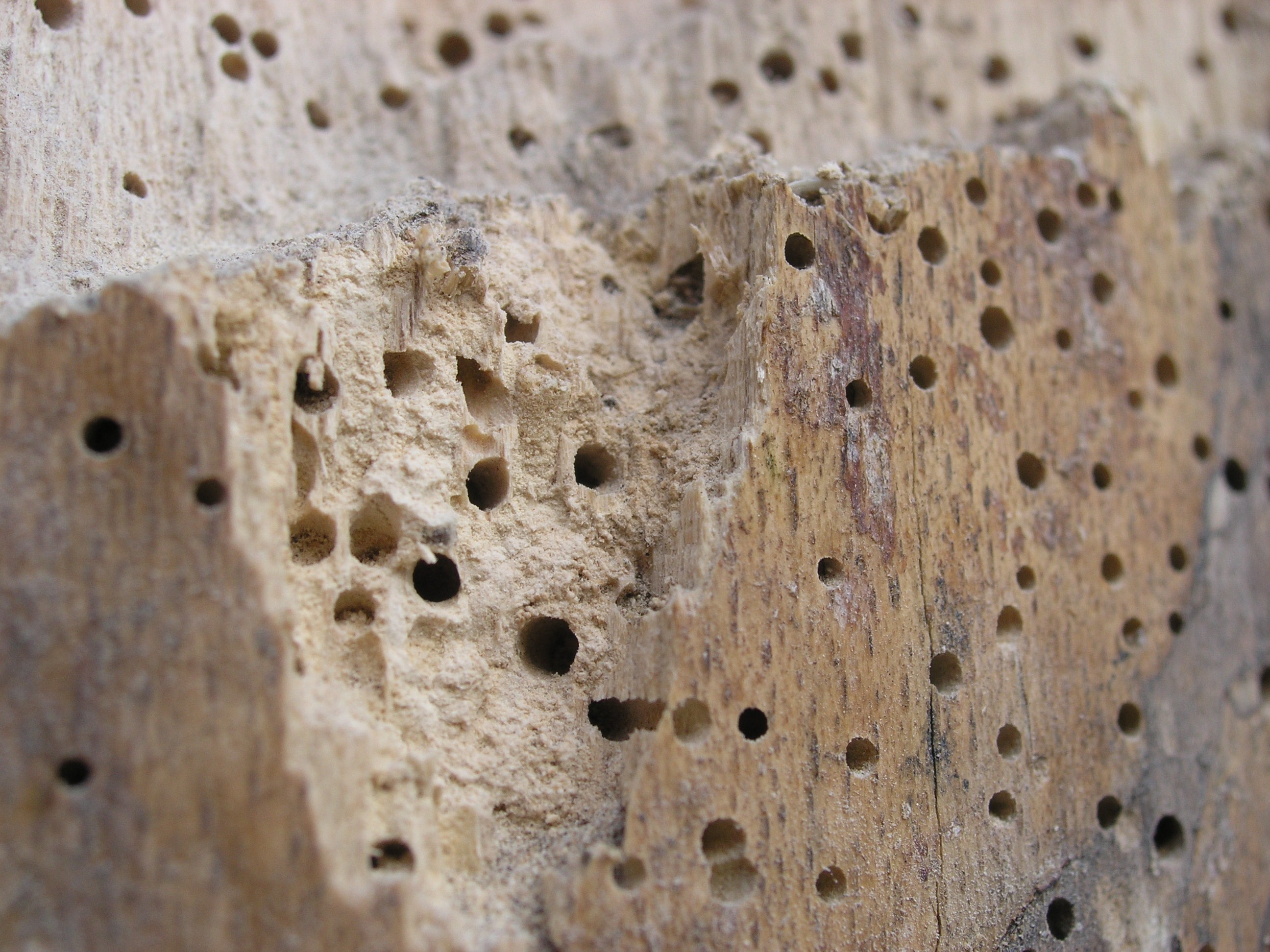

The council's signs:20
- Active: "An active outbreak can sometimes be identified by holes with sharp (rather than rounded) edges, alongside bore dust. The interiors of the holes ... are not dark, but the colour of freshly-cut timber."
- Old: "Otherwise, holes may indicate an old infestation, that's no longer active. In these cases, no action is normally needed."
- The common furniture beetle makes holes 1 to 2 mm wide.
- Not sure? Watch for a year. "Water-soluble glue can be used to cover a group of holes with acid-free tissue paper. If there are beetles, they will punch their way out."
Then the cause, and the mechanism as far as the council gives one: "Wood-boring insects are a symptom of excess damp in a building", because a house at normal temperature and humidity is hostile to timber pests, and an infestation "is likely to continue until humidity levels are reduced". In old buildings it blames the damp most often on impermeable finishes such as cement render or modern paints.20 That's the ground of lessons 17 and 18: find the water before you treat the wood.
On treatment, the council says an active infestation "might need" treatment straight away, prefers a paste to a spray, and says: "For a comprehensive spray treatment, you will need listed building consent." That rule is about listed buildings, on a page about one council's district, not a rule for every house. The commercial view, that active woodworm needs chemical treatment as a rule, this course saw only in search snippets from treatment firms, so it does not state it, and it does not settle the difference.
The tissue-paper test, on timber that's yours (or with your landlord's agreement), is Yours. An active attack in the fabric of a house is Call someone. For listed buildings the council recommends "a surveyor, or an engineer who is accredited to work in historic buildings", for an independent assessment before spraying; a surveyor first for any house, to find the damp, is this course's reading.
Termites, in the US
Termites are a US pest in this course's sources; it read nothing on them in the UK. EPA says they cause "billions of dollars in structural damage" a year.21 The signs: hollow spots in exposed wood when you probe it with a flathead screwdriver, and swarms. Ants get mistaken for them; EPA's test is the wings (a termite's roughly equal in length, an ant's front pair longer) and the antennae (straight on a termite, bent at a right angle on an ant).21 EPA's prevention list, which lesson 17 began: dry soil at the foundation, gutters and downspouts working, leaks fixed, no firewood against the house. EPA gives no reason for keeping the soil dry, and this course doesn't add one.
Treatment isn't a householder's job on EPA's account: "In most cases, termiticide application can only be properly performed by a trained pest management professional", and soil treatments done badly "can cause contamination of the home and surrounding drinking water wells". And, as EPA states it: "Firms offering termite services must be licensed by your state."21 Termites are Call someone.
Checking a pest controller
- In the UK, the British Pest Control Association, a trade association, describes its members as having "at least £2M public liability insurance" and being audited to "the British standard in pest management BS EN 16636". That's the association on its own members; check a company on its own site, not by a logo.22 HSE, which recommends no companies, suggests your local council.2
- In the US, EPA says to ask to see a termite firm's state licence and to take concerns to your state pesticide regulatory agency, and, for bed bugs, to ask for an IPM approach.2116
Lesson 23, "Hiring a tradesperson, and when to stop", covers hiring in general.
Droppings in a flat in Milton Keynes
The simple case first. In a 1970s flat in Milton Keynes, the tenant finds droppings in the cupboard under the sink and a chewed corner on a packet of rice. It's the first sign in two years.
- Identify. Small, dark, pointed at one end: mouse droppings, on CDC's description.3
- Threshold. Fresh signs in one cupboard: enough to act, not a reason for poison.1
- Tell the landlord, in writing; anything that changes the building needs their agreement (this course's line).
- Look for the way in. Round the pipes under the sink is on CDC's list; anything pencil-width counts. A gap round a gas pipe goes to the landlord, not to the steel wool.4
- Food. Rice and cereals into sealed containers.4
- Clean up by CDC's method: window open 30 minutes, out of the room, gloves, soak with disinfectant or 1 part bleach to 9 of water for 5 minutes, paper towels, wipe the cupboard.6
- Trap. Snap traps, baited end to the wall, in the cupboard and behind the fridge, checked daily.5 Not a glue board: in England, setting one is an offence under the 2022 Act unless it's done under a licence.10
- The all-clear. A week with no catches and no new signs, and no fresh droppings after the clean-up.53
Poison comes in only if trapping fails, and then a public product by its label, or a pest controller.9 The traps are Yours, the clean-up Yours, on conditions, and the building work the landlord's.
Cockroaches in a Philadelphia apartment
In an apartment building in Philadelphia, a tenant has German cockroaches in the kitchen. She's set off two foggers in the last month, and the numbers seem worse. Her neighbours across the hall have them too. She's thinking of a third fogger, and a stronger one.
Before you read on: what did the two foggers most likely do, on the studies and UC's guide, and what should she do instead, in order?
Show the answer
On DeVries and colleagues' first study, foggers "failed to reduce cockroach populations", and they left kitchen surfaces with pesticide residues that averaged 603 times the level before.14 On the second, apartment cockroaches were highly resistant to a common fogger chemical, and the authors say their results "suggest" that resistance is a major reason.15 On UC's guide, the foggers may also have pushed them elsewhere, which fits the neighbours having them.13 The authors suggest foggers "would lack efficacy" in homes like hers.15
Instead: (1) tell the landlord in writing, since it is a building-wide problem (this course's reading); (2) sanitation, food sealed away, leaks reported; (3) gel baits near where they hide, used by the label, and patience, since UC says 7 days or longer; (4) sticky traps to see where they are and whether the numbers fall; (5) a professional who uses IPM, through the landlord.13
The wrinkle is the building: the cause isn't only in her flat. And nothing in either study blames the tenant.
What people get wrong
"A bug bomb will clear cockroaches." In the DeVries study foggers didn't reduce them, and left heavy residues; baits did.14
"Sweep up the droppings, then disinfect." CDC says never sweep or vacuum them; air the room, soak them, then wipe.6
"A glue board is fine anywhere." CDC advises against them for health reasons, and England, Wales and Scotland each now make setting or using them an offence in their own way (see the glue traps section).5101112
"Bed bugs mean a dirty home." EPA: they're attracted to warmth, blood and carbon dioxide, not dirt. EPA knows of no cases or studies showing they spread disease between people.17
"Holes in the wood mean live woodworm." Babergh and Mid Suffolk's page: they may be an old attack, needing no action; if unsure, watch for a year.20
"An outdoor pesticide will be stronger indoors." EPA: "Never use a pesticide indoors that is intended for outdoor use."18
Practice
Take 30 minutes over this, with a torch (flashlight) and a notebook. It is looking and listing. Don't touch or sweep any droppings, don't set poison or a fogger, and don't fill, pack or disturb anything round a gas pipe, meter or electricity cable. Don't climb a ladder for it. If you rent, you list; changing anything waits for your landlord's agreement.
- Gaps. Walk CDC's list: under and behind the kitchen units and appliances, round the pipes under the sink, cupboard corners, doors and windows; outside, from the ground, the foot of the walls, vents, and where pipes and cables go in. Note every gap pencil-width or bigger, and who deals with each.
- Food and water. Anything in open packets, pet food left down, a dripping tap or a damp cupboard base (lesson 18 if so).
- Signs. Droppings, gnaw marks, holes in timber, damage to wool, anything on a mattress seam. For each, name what it might be and what would confirm it.
- Woodworm, if you have old holes in timber that's yours to mark: start the council's tissue-paper test on one group of holes, with water-soluble glue and acid-free tissue, and write the date in your calendar a year ahead.
- Decide. For each finding, the IPM step it belongs to, and its label: Yours, Yours on conditions, or Call someone.
Three finds. Decide each, with its source and its label. (1) In a rented flat in Stornoway, a few droppings under the sink and a glue board a previous tenant left behind a cupboard. (2) In a house in Charleston, winged insects swarming from a baseboard in spring, and a door frame with hollow spots when probed. (3) In a house in Tamworth, a wool rug with bare trails and small white larvae underneath.
Show the answer
(1) Mice, probably. CDC's steps: seal up, snap traps, clean up by its method, and the landlord told in writing.456 The glue board is a legal question in Scotland, where the 2024 Act makes using and possessing one without reasonable excuse an offence unless authorised; tell the landlord it's there and ask the council how to dispose of it, which is this course's line.12 Label: Yours for the traps, Yours on conditions for the clean-up, the landlord's for the building.
(2) Possibly termites; EPA says swarms and hollow wood are the signs, and to check the wings and antennae against ants. In most cases treatment needs a trained professional, and the firm a state licence, on EPA's account. Label: Call someone.21
(3) Clothes moth larvae, on the NHM's description of the damage. Freezing at -20°C for a week or heating to 49°C for over 30 minutes kills all stages, and vacuuming helps. Label: Yours.19
For your plan
To the calendar: the pest walk-round from the exercise, once in spring and once in autumn, and the tissue-paper test's check date a year from now. To the stop list: no foggers, no glue traps, no poison marked for professionals, no sweeping droppings, no filling round gas pipes, meters or cables. To the call list: a pest controller, checked on the trade association's or your state's own site.
Connections
Lesson 17, "Keeping water out: roof, gutters, ground and walls", gave EPA's dry-soil rule for termites, and lesson 18, "Damp inside: condensation, mould, ventilation and rising damp", the damp that woodworm follows. Cooking Fundamentals lesson 4, "What makes people ill, and the rules that stop it", keeps kitchen hygiene. Next, lesson 22, "Who may do what: reserved work, and the argument about licensing", gathers the rules on who may do which job.
Go deeper
- University of California Statewide IPM Program, "Pest Notes: Cockroaches". Read here in full. With how to place baits and traps.
- CDC, "Controlling Wild Rodent Infestations" and its three linked pages. Read here in full, from Internet Archive captures. Keep the clean-up page.
- HSE, "Using biocides: Overview". Read here in full. The regulator on whether you need a product at all, and reading the label.
- DeVries and colleagues, "Exposure risks and ineffectiveness of total release foggers", BMC Public Health, 2019. This course read the abstract only.
Sources
- US Environmental Protection Agency, "Integrated Pest Management (IPM) Principles", last updated 22 July 2026. Read: full text, re-read 26 September 2026. Written mainly for growers.
- Health and Safety Executive, "Using biocides: Overview". Read: full text, 26 September 2026. Guidance for workplaces and homes, Great Britain and Northern Ireland.
- Centers for Disease Control and Prevention, "Controlling Wild Rodent Infestations", dated 8 April 2024. Read: full text, from Internet Archive capture 20260913133434, re-read 26 September 2026.
- Centers for Disease Control and Prevention, "How to Seal Up to Prevent Rodents", dated 8 April 2024. Read: full text, from Internet Archive capture 20260917020302, re-read 26 September 2026.
- Centers for Disease Control and Prevention, "How to Trap Up to Remove Rodents", dated 8 April 2024. Read: full text, from Internet Archive capture 20260806235217, re-read 26 September 2026.
- Centers for Disease Control and Prevention, "How to Clean Up After Rodents", dated 8 April 2024. Read: full text, from Internet Archive capture 20260918085500, re-read 26 September 2026.
- US Environmental Protection Agency, "Restrictions on Rodenticide Products". Read: full text, re-read 26 September 2026. EPA's 2008 decision document itself was not read.
- US Environmental Protection Agency, "Introduction to Pesticide Labels", last updated 2 June 2026. Read: full text, 26 September 2026. The federal statute and regulations it names were not read.
- Health and Safety Executive, "Rodenticides". Read: full text, re-read 26 September 2026.
- Glue Traps (Offences) Act 2022, on legislation.gov.uk, and the Glue Traps (Offences) Act 2022 (Commencement) Regulations 2024 (SI 2024/686). Read: the whole Act, and the commencement regulations, 26 September 2026.
- Agriculture (Wales) Act 2023, section 46 and its commencement note, on legislation.gov.uk. Read: Part 5 (sections 45 to 48), and sections 11 and 16(3) of the Wildlife and Countryside Act 1981 as amended, 26 September 2026.
- Wildlife Management and Muirburn (Scotland) Act 2024, sections 1 to 5, on legislation.gov.uk. Read: sections 1 to 5 and the commencement notes, 26 September 2026. The authorisation scheme made under section 5 was not read.
- A. M. Sutherland, D. H. Choe and M. K. Rust, "Pest Notes: Cockroaches", UC ANR Publication 7467, University of California Statewide IPM Program. Read: the whole page, re-read 26 September 2026. Written for California.
- Z. C. DeVries, R. G. Santangelo, J. Crissman, R. Mick and C. Schal, "Exposure risks and ineffectiveness of total release foggers (TRFs) used for cockroach control in residential settings", BMC Public Health 2019;19:96. Read: abstract only, re-read 26 September 2026.
- Z. C. DeVries and colleagues, "Pervasive Resistance to Pyrethroids in German Cockroaches (Blattodea: Ectobiidae) Related to Lack of Efficacy of Total Release Foggers", Journal of Economic Entomology 2019;112(5):2295-2301. Read: abstract only, re-read 26 September 2026.
- US Environmental Protection Agency, "Top Ten Tips to Prevent or Control Bed Bugs", last updated 19 August 2026. Read: full text, re-read 26 September 2026.
- US Environmental Protection Agency, "Bed Bug Myths". Read: full text, re-read 26 September 2026.
- US Environmental Protection Agency, "Safety Issues in Controlling Bed Bugs", last updated 8 September 2026. Read: full text, re-read 26 September 2026.
- Natural History Museum, "Clothes moths identification guide". Read: full text, re-read 26 September 2026.
- Babergh and Mid Suffolk District Councils, "Wood-boring insects". Read: full text, re-read 26 September 2026. A council heritage page, about historic buildings in its district.
- US Environmental Protection Agency, "Termites: How to Identify and Control Them", last updated 21 October 2025. Read: full text, re-read 26 September 2026.
- British Pest Control Association, "Find a pest controller". Read: full text (short), from Internet Archive capture 20260208074048; the live page refused automated reading on 26 September 2026. A trade association describing its own members.
- US Consumer Product Safety Commission, Publication 5133, "Preventing Home Fires: Arc Fault Circuit Interrupters (AFCIs)", dated R042012. Read: full text.
- Health and Safety Executive, Electricity at work: Safe working practices, HSG85, third edition, 2013. Read: the whole PDF extracted; "Proving dead" paragraphs 53 to 55 read. Workplace guidance, used here only for what it says about non-contact testers.
Check your understanding
This lesson has a 6-question quiz. Pass it and the questions come back on a schedule in Review, so what you learned stays learned. Your progress is saved in your browser; no account needed.