Tyres II: tread, damage, age, and when to replace
100 min
Two hosts talk the lesson through. The voices are synthetic; the script was written from this lesson and checked against it, and asserts nothing the lesson does not.
- State, as general information, Great Britain's tread rule exactly (1.6 mm in a continuous band across the central three-quarters of the tread, all the way round) and the 2/32-inch inspection rules in Pennsylvania, New York and Virginia, including how each is measured, and that federal tread rules cover commercial vehicles
- Measure tread with a gauge, the wear bars or a coin, and say what each coin test can and can't show
- Identify tyre damage that breaks the rules read here at any tread depth, and read a tyre's age against the ranges the sources give, saying which are law and which are advice
- Compare the legal floor with the earlier replacement points that are recommended, and with the argument against them, naming who holds each position and what each sells
AAA, the US motoring clubs that sell roadside assistance and run a repair network, tested new tyres against tyres worn to 4/32 of an inch, about 3.2 mm on this course's conversion, on wet pavement at highway speed. The worn ones took on average 87 feet longer to stop in a passenger car, which AAA reports as a 43 per cent increase.19 That's well above any legal minimum this course read. So the law sets a floor and the advice sits above it. Most of that advice comes from bodies that sell tyres, cover or repairs, and a tyre maker argues that depth alone is the wrong test.
This course is education, not mechanical training, and not legal advice about your own car. If your car fails on a motorway or other fast road in Great Britain, leave at the next exit or services if you can; if you can't, go left into an emergency area or onto the hard shoulder, switch on your hazard lights, get everyone out on the side away from traffic and behind the barrier if there is one, and don't go back to the car. If you're stuck in a live lane or can't get out safely, stay in with seat belts and hazard lights on and call 999 and ask for the police. In the US, pull as far onto the right shoulder as you can, switch on your hazard lights and stay in with your seat belt on, unless the shoulder is too narrow or there's a guardrail to wait behind, in which case get out on the side away from traffic; call 911 in an emergency. Never put any part of your body under a car held up only by a jack, and never touch the orange high-voltage cables on a hybrid or electric car. The law on a car's condition differs between Great Britain, Northern Ireland and each US state, and it changes.
Much of this lesson states law. This is general information, not legal advice. The rules differ between England and Wales, Scotland, Northern Ireland and each US state, and they change.
What the tread is for
NHTSA, the US federal road safety regulator, says "Tire tread provides the gripping action and traction that prevents your car or truck from slipping and sliding, especially when the road is icy or wet."13 TyreSafe, a UK tyre safety charity backed by tyre makers, carmakers and retailers, gives the account in terms of water: "The deeper the tyre tread, the more water it can clear from the road surface and the better its grip. As the tread wears down or water depth increases, grip is reduced."15 When the water can't get out of the way, TyreSafe says, the tyre aquaplanes (hydroplanes, in the US): "Aquaplaning occurs when the water cannot be removed from between the tyre and the road."15
That's as far as the sources read here go. They describe what tread does and measure what happens as it wears; none of them gives the physics of how a groove clears water, and this course won't supply it.
How much tread there is to start with depends on the tyre. TyreSafe says "New tyres generally have a tread depth of between 7-9 mm", varying with the brand, model and season.15 The AA, a motoring organisation that sells breakdown cover and repairs, says new tyres start "with about 8 mm".17 Everything below is about what happens to that 7 to 9 mm on the way down.
The tread rule in Great Britain
This is general information, not legal advice.
The rule for cars is regulation 27(4)(f) of the Road Vehicles (Construction and Use) Regulations 1986, as amended. Read it in full, because every word of it does work:
the grooves of the tread pattern of every tyre fitted to the wheels of a vehicle mentioned in sub-paragraph (e) shall be of a depth of at least 1.6 mm throughout a continuous band comprising the central three-quarters of the breadth of tread and round the entire outer circumference of the tyre.1
The vehicles in sub-paragraph (e) include "passenger vehicles other than motor cycles constructed or adapted to carry no more than 8 seated passengers in addition to the driver", which is a car.1 Take the words one at a time.
- "the grooves of the tread pattern". Regulation 27(6) says the tread pattern excludes "(i) tie bars or tread wear indicators; (ii) features which are designed to wear out substantially before the rest of the pattern under normal conditions of use; and (iii) other minor features".1 DVSA's MOT manual, the rulebook for Great Britain's periodic test, puts it simply: grooves with wear indicators in them, or cut as deep, "are considered to be primary grooves", and shallower grooves "are not to be considered when assessing tread depth".2
- "a continuous band comprising the central three-quarters of the breadth of tread". The breadth of tread, defined in regulation 27(6), is "the breadth of that part of the tyre which can contact the road under normal conditions of use measured at 90 degrees to the peripheral line of the tread".1 So the band is the middle three-quarters of the part that touches the road. The MOT manual spells out what that leaves: "Either side of the central three-quarters of the tyre can be devoid of tread ('bald')."2
- "round the entire outer circumference". All the way round. One good point doesn't carry a worn one.
The Highway Code's Annex 6 gives the same rule as a MUST: "Cars, light vans and light trailers MUST have a tread depth of at least 1.6 mm across the central three-quarters of the breadth of the tread and around the entire circumference."3 Bigger vehicles and motorcycles have a 1 mm rule in the same regulation; this lesson is about cars.
What follows from breaking it
Using a car whose tyres break a construction and use requirement is an offence under section 41A of the Road Traffic Act 1988.4 The Sentencing Council's guideline for England and Wales, "Tyres defective", gives a Level 4 maximum fine for vehicles up to 3.5 tonnes, £2,500 on its own table, and "Must endorse and impose 3 points", which means the offence and the points go on the driver's record.5 DVLA's code for it is CU30, "Using a vehicle with defective tyre(s)".6 Then the line the advice pages read here state differently:
Fine is for each single tyre (but ordinarily only one set of points apply where several offences committed on the same occasion).5
So the fine can multiply by the tyre, and the points ordinarily don't. The tread page of TyreSafe, a charity backed by tyre makers, carmakers and retailers, says "three penalty points PER tyre"; the AA, which sells breakdown cover and repairs, says four dangerous tyres could mean "a £10,000 fine and 12 points"; and the RAC, which sells breakdown cover and tyres, lists "Three penalty points per illegal tyre". The Sentencing Council, which issues the sentencing guidelines for England and Wales, says that ordinarily only one set of points applies.5151718 Scotland's penalties weren't read by this course. At the MOT, "Tyre tread depth not in accordance with the requirements" is a Dangerous defect.2
One more piece of law makes the checks you'll do below count. Section 48 of the Road Traffic Offenders Act 1988 says the court must not endorse or disqualify for a section 41A offence if the driver proves "that he did not know, and had no reasonable cause to suspect, that the facts of the case were such that the offence would be committed".7 The fine still applies. On this course's reading, the exemption is narrow for a driver: a worn or damaged tyre that could be seen gave cause to suspect, whether or not anyone looked. The checks below are how you find it first. Lesson 20, "The law on a car's condition: Great Britain and Northern Ireland", has the rest. None of this section reaches Northern Ireland: Northern Ireland's own law on a car's condition wasn't read here, so a reader there checks nidirect instead.
A tyre in Hawes
A driver in Hawes checks her tyres with a tread depth gauge at three points round each one. On one front tyre the grooves across the middle read 2.4 mm at every point, and the outer shoulder (the edge of the tread, where it turns down to the sidewall) is worn smooth all the way round.
The law first. Every primary groove in the central band is above 1.6 mm, all the way round, and the MOT manual says the edges outside that band can be bald. On the depth rule, as general information, the tyre meets regulation 27(4)(f).
Then the advice, beside it. The AA, which sells breakdown cover and repairs, says "Aim to replace tyres before the tread wears below 2 mm", and the same AA page says "You should consider replacing them at 3 mm". TyreSafe, the industry-backed charity, says "Tyre and safety experts recommend replacing tyres at 3mm".1517 So this lawful tyre sits under the 3 mm point both give, and above the 2 mm point they also both give. Who says what, and why, including a tyre maker's case against replacing by depth alone, is the last main section of this lesson.
And one more reading. Wear on one edge, on the account of AAA (whose clubs sell roadside assistance and run a repair network) in lesson 7, "Tyres I: pressure, the placard and TPMS", typically means wheels out of alignment.20 Measuring the depth is Yours. The alignment is Call someone.
Tread rules in the US
This is general information, not legal advice.
The federal tread figures, 4/32 of an inch on the front tyres of a bus, truck or truck tractor and 2/32 elsewhere, are in 49 CFR 393.75, which is part of the Federal Motor Carrier Safety Regulations and covers commercial motor vehicles.11 This course found no federal tread minimum that binds a private car's driver: the federal 2/32 for cars is a standard for states that inspect (lesson 22, "The US: state inspections, emissions tests and tread law"). For driving a private car, tread law is set by states. The three states read here all use 2/32 of an inch, which is about 1.6 mm (this course's arithmetic: 2/32 × 25.4 = 1.59). The number nearly matches Great Britain's, and the way it's measured doesn't.
| The rule | How it's measured | |
|---|---|---|
| Great Britain | 1.6 mm (reg 27(4)(f)) | A continuous band across the central three-quarters, all the way round[1] |
| Pennsylvania (inspection) | Reject if "A tire has two adjacent treads with less than 2/32-inch tread remaining at any point"8 | Any one point; also reject if the wear indicators "contact the road in any two adjacent grooves"8 |
| New York (inspection) | "must be at least 2/32 inch"9 | "when measured in two adjacent major tread grooves showing the most wear"9 |
| Virginia (inspection) | Reject "a tread depth measuring less than 2/32 of an inch"10 | Two adjacent grooves "where tread is thinnest"; if both are under, measure at two more points round the tyre; reject only if under at all three. "Do not take measurements from the tread wear indicators."10 |
(The rest of Pennsylvania's sentence sets 4/32 inch for the front tyres of vehicles over 10,000 pounds, which aren't cars.) Each of these is a rule for the state's inspection. What any of them requires of a driver between inspections is a question this course didn't read, and lesson 22 keeps to what was read. Many states don't inspect at all.
Beside the law sits the regulator's advice. NHTSA: "Tires are not safe and should be replaced when the tread is worn down to 2/32 of an inch."13 That's advice from the federal regulator, for any car in the US, and it isn't law.
A tyre in Lynchburg, Virginia
A car goes in for its annual inspection in Lynchburg, Virginia. On the front left tyre the inspector finds where the tread is thinnest and measures two adjacent grooves there: 1/32 inch and 1/32 inch. Both are under 2/32. So, following Virginia's manual, the inspector measures again "at two additional equally spaced intervals around the circumference". At the second point the two grooves read 3/32 and 3/32; at the third, 3/32 and 4/32.
Virginia's rule rejects the tyre only "If the tread depth is less than 2/32 of an inch in two adjacent tread grooves at each of the equally spaced intervals".10 It isn't at the second or third point, so on depth, as general information, the tyre isn't rejected. The same tyre in Pennsylvania would be rejected, because there one point with two adjacent grooves under 2/32 is enough.8 And in Great Britain, a spot at 1/32 inch (about 0.8 mm) in the central band breaks the "round the entire outer circumference" requirement.1 One tyre, three verdicts, on this course's reading of each rule. NHTSA's advice, in the US, is that tyres "are not safe and should be replaced" at 2/32 inch, and this one is past that at its thinnest spot.13
Now the gap. The rear right tyre on the same car: at its thinnest spot, two adjacent grooves read 1/32 inch and 3/32 inch, and nowhere on the tyre are two neighbouring grooves both under 2/32.
Before you open this: under Virginia's manual, does the inspector need to measure anywhere else on the rear right tyre, and is it rejected on depth?
Show the answer
No further measurement, and not rejected on depth. Virginia's note: "If either of the grooves measure 2/32 of an inch or more, no further measurements are necessary and tread depth is satisfactory."10 One of the pair reads 3/32, so the rule stops there. If you went on to the two extra points, look again at the word "either". In Pennsylvania the answer is the same for a different reason: its rule needs two adjacent grooves both under 2/32 at a point, and this tyre has none. Passing Virginia's depth check says only that. A groove at 1/32 inch is under every figure in this lesson, law or advice, and below where any position in the last section begins: Virginia's own 2/32 is the line it's measured against, and NHTSA's advice is that a tyre worn to 2/32 is "not safe".
Measuring: the gauge, the bars and the coins
A tread depth gauge measures the groove itself. The AA, which sells breakdown cover and repairs, calls "a calibrated tyre gauge" the best way: "To use, place the gauge into the tyre's groove."17 Measure in the main grooves, the ones with wear indicators in them, and not on the indicator bars themselves. That's Virginia's instruction to its inspectors, and on this course's reading it follows from the GB regulation's exclusion of the bars too.110 Measure at several points: TyreSafe, the industry-backed charity, says "check at least three locations around each tyre", and AAA, whose clubs sell roadside assistance and run a repair network, says to measure in "three locations across the tire's tread: (1)outer edge, (2) center, and (3) inside edge".1520 Together that's three points round the tyre and three across it.
The wear indicators are raised bars across the bottom of the main grooves. In the US, FMVSS 139 requires new car tyres to have at least six, spaced round the tyre, that let you see "whether the tire has worn to a tread depth of one sixteenth of an inch", which is 2/32.12 The AA describes them as "usually small bars, about 5 mm wide", and says "If the tyre tread is level with the top of the wear indicator, it means your tyres have reached the legal limit of 1.6 mm."17 The photograph below shows where they are: look for the letters TWI near the edge of the tread.
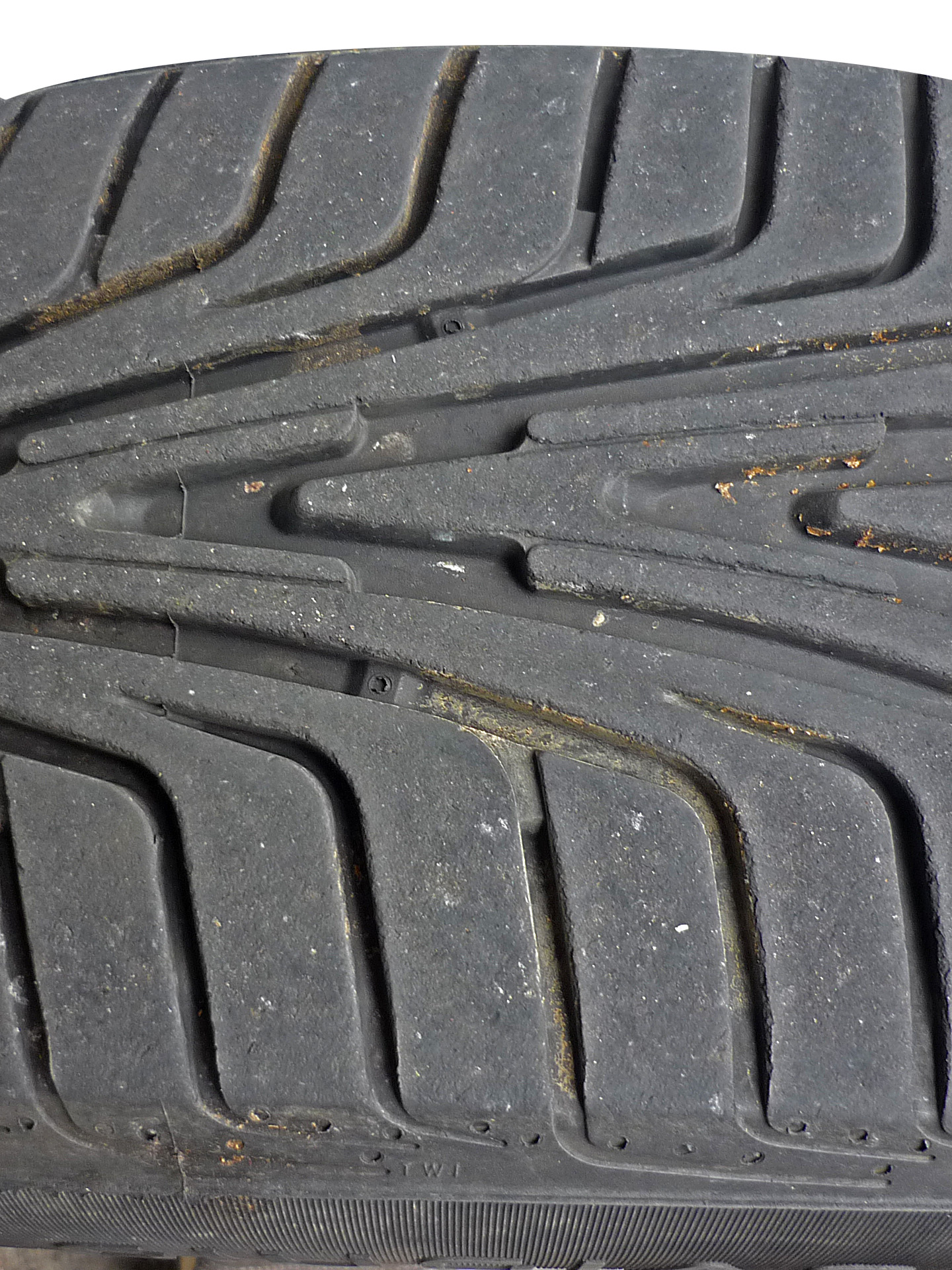
The coins are quick and rough, and each one measures one depth only.
| In the UK | In the US |
|---|---|
| The 20p. TyreSafe (a charity backed by tyre makers, carmakers and retailers): "If the outer band of the 20p coin is obscured when it is inserted, then your tread is above the legal limit. If the outer band of the coin is visible, then your tyres may be illegal and unsafe and should be checked immediately by a qualified tyre professional."15 | The penny. NHTSA: "placing a penny in the tread with Lincoln's head upside down and facing you. If you can see the top of Lincoln's head, replace your tires."13 AAA (its clubs sell roadside assistance and run a repair network): a visible head means "less than 2/32" of tread.20 |
| The AA (which sells breakdown cover and repairs) gives the width: the 20p's outer rim "is just under 3 mm wide", so a hidden rim means "comfortably above the legal minimum".17 | The quarter. AAA: put a quarter in a groove with Washington's head down; "If the top of his head is not visible, your tires have at least 4/32” of tread and are fine for continued use."20 |
The 20p's outer band shows at one point on a tyre in Britain. Is that tyre under the legal limit at that point?
Show the answer
Not necessarily. On the figure from the AA, which sells breakdown cover and repairs, the band is just under 3 mm wide, so a visible band means the tread there is under about 3 mm, not under 1.6 mm. It's why TyreSafe, a charity backed by tyre makers, carmakers and retailers, says "may be illegal", and why the AA says to check "more carefully using a proper tyre tread depth gauge". The coin's line sits at nearly twice the legal depth, so it can warn early; it can't pass or fail a tyre.
The 20p's band width rests on the AA alone; this course read no specification for the coin. Some pages put the test more loosely: the RAC, which sells breakdown cover and tyres, says "If you can't see the outer band on the coin, your tyres are above the legal limit", which says nothing about the other points round the tyre.18 The penny and the quarter are the US versions: the penny sits at the 2/32 figure, the quarter at AAA's 4/32.
Checking the tread is Yours. NHTSA says to do it "at least once a month when you're checking their pressure", TyreSafe "at least once a month and before any long journeys", and the RAC suggests the coin test "around every two weeks and before long journeys".131518
Damage that counts at any depth
This is general information, not legal advice.
A tyre can have plenty of tread and still be barred. In Great Britain, regulation 27(1) says a tyre shall not be used on a road if it has any of these, among others:1
- "(c) the tyre has a cut in excess of 25 mm or 10% of the section width of the tyre, whichever is the greater, measured in any direction on the outside of the tyre and deep enough to reach the ply or cord;"
- "(d) the tyre has any lump, bulge or tear caused by separation or partial failure of its structure;"
- "(e) the tyre has any of the ply or cord exposed;"
A catch-all, 27(1)(h), covers a tyre "not maintained in such condition as to be fit for the use" or with "a defect which might in any way cause damage to the surface of the road or damage to persons on or in the vehicle or to other persons using the road".1 At the MOT, a qualifying cut is a Major defect, and a lump, bulge or tear, or exposed cords, is Dangerous.2
The states read here have their own lists. Pennsylvania rejects a tyre if "A part of ply or cord is exposed" or there is "a bump, bulge or separation".8 New York checks for "any fabric break or cut over the length or width of 1 inch, visible bumps, bulges or knots".9 Virginia rejects "Any tire has a cut or puncture into the fabric", and allows plugs or patches "in the tread area only".10 One inch is 25.4 mm, so New York's cut figure and Great Britain's 25 mm nearly match, on this course's arithmetic; Great Britain also has the 10 per cent alternative and requires the cut to reach the ply or cord.
The advice read here points the same way. TyreSafe, the industry-backed charity: "If the tyre has lumps or bulges it must be examined by a tyre specialist since these could indicate internal damage."15 NHTSA says to stop using a tyre for "signs of physical damage (cuts, cracks, bulges, etc.)".13 Spotting damage is Yours. What to do with a damaged tyre, and whether to drive on it at all, is lesson 18's, "A flat tyre: the decision, and spare, space saver, sealant or run-flat"; any repair is Call someone.
Sort these four tyres, as general information, against Great Britain's regulation 27. (a) 5 mm of tread and a cut 15 mm long that shows cord. (b) 2 mm across the central band all round, and a small scuff on the sidewall with no bulge or cord showing. (c) 6 mm of tread and a bulge on the sidewall. (d) 1.7 mm across the central band all round, and a cut 30 mm long, in a tyre whose section width is 205 mm, that doesn't reach the cord.
Show the answer
(a) Barred: 27(1)(e), any ply or cord exposed, whatever the cut's length. (b) Not barred by the rules quoted here: the depth is above 1.6 mm all round and there's no cut to the ply, bulge or exposed cord, though it's at the 2 mm point of the AA, which sells breakdown cover and repairs. (c) Barred: 27(1)(d), a bulge. (d) Not barred by 27(1)(c), because the cut must reach the ply or cord as well as exceed the length (25 mm, or 10 per cent of 205 mm, which is 20.5 mm, whichever is greater, so 25 mm here; this course's arithmetic). Depth meets 27(4)(f). If you barred (d) on length alone, reread the words "and deep enough to reach the ply or cord".
Age
This is general information, not legal advice.
A ten-year-old tyre with plenty of tread is on a family car in Great Britain. Does the law there set an age limit that it breaks? Decide before you read on.
Show the answer
Not on what this course read. Regulation 27 has a ten-year rule, but regulation 27(1A) limits it to certain tyres on buses, minibuses and heavy goods vehicles (front axles, and a minibus's single wheels). What exists for cars is advice, from NHTSA and the RAC (which sells breakdown cover and tyres), and it's set out below.
Tyres age whether or not they're used. NHTSA: "Tire aging occurs when the rubber and other components in a tire change over time due to service, storage, and environmental conditions." Most drivers wear the tread out first, it says, and the ones at risk from age are low-mileage cars and vehicles that stand: "exposure to sunlight and warmer climate, poor storage and poor maintenance also contribute to tire aging." And: "You cannot detect tire aging simply by looking at your tires."13
That ageing happens is common ground. How fast it matters is not, and the sources give ranges, not a rule:
- NHTSA: "Some vehicle and tire manufacturers recommend replacing tires that are six to 10 years old, regardless of treadwear."13 Its winter page: "Some vehicle manufacturers recommend replacing tires every six years regardless of use."14
- The RAC, a UK motoring organisation that sells breakdown cover and tyres: "Even if you drive limited miles each year, tyres should be replaced every five or six years."18
None of that is law. Great Britain's ten-year rule doesn't reach cars, as the predict above showed, and the three states' tyre rules read here set no age limit either.18910 DVSA's manual does say "Tyres with a three-digit code will be more than 10 years old", which is useful for reading the date on any tyre.2 Lesson 7 showed how to read the four-digit code. Your handbook, and the tyre maker, are where a figure for your car and tyre comes from; the ranges above are other people's.
NHTSA also warns about the spare: "Spare tires on all vehicles are prone to aging because they seldom get replaced", and says a full-size spare should not be "used as a replacement for worn tires, except in emergencies such as replacing a flat tire".13
When to replace: the argument above the floor
Everyone read here agrees that the legal floor is where the law of each place puts it. And every party that argues about replacing above it agrees that wet braking gets worse as a tyre wears: even the tyre maker arguing for full use says so. Where they part is where, above the floor, a tyre should come off, and that turns on facts that are disputed and on a value question, how much safety margin is worth how much money and waste. This course takes no side. The positions follow, each in its holder's words, with what each sells. Logic and Argument lesson 7, "Reconstruction and charity: the strongest version first", is the rule for reading them, and Personal Safety lesson 5, "Home, the door and the doorstep", has the same kind of argument about burglar alarms, with its point that who paid for a study doesn't tell you its result is wrong; the design does.
The chart puts the positions on one scale. Read it from the bottom: the two legal floors are almost the same depth, and everything above them is somebody's advice. From the top, a new tyre has 7 to 9 mm to lose, and the argument is about whether it should come off at the floor, where NHTSA's advice sits, or up to 1.6 mm above it, on this course's arithmetic. The AA and TyreSafe each give two points, 2 mm and 3 mm, in different words, and the quotations below keep both. NHTSA's advice sits at the US floor. One position can't go on this scale: Michelin's, that the tyre's design matters more than its depth alone.
Replace earlier: 3 mm, or 4/32 inch
TyreSafe, the UK tyre safety charity backed by tyre makers, carmakers and retailers, says "Tyre and safety experts recommend replacing tyres at 3mm", and on the same page: "You should have your tyre replaced once it reaches 2mm and the minimum tread depth commonly advised by tyre and safety experts is 3mm." Its reason is wet grip: "in general wet grip decreases as the tyre tread depth approaches the legal minimum", and "motorists may wish to consider replacing tyres before reaching the tyre tread limit."15 It cites a test in which cars on 1.6 mm tread had wet braking distances up to 44 per cent longer than on 3 mm. This course has not read that test's report, so the figure is TyreSafe's.
The RAC, a motoring organisation that sells breakdown cover and, on the same page, tyres ("RAC Tyres where we sell everything from budget to premium brands"), says: "Tyre and safety experts believe the 1.6mm legal minimum is insufficient to guarantee safety". It goes on to say most recommend 3 mm, and gives the same comparison: "The difference in wet braking distance between a tyre worn to 3mm and one worn to 1.6mm can be as much as 44%."18
The AA, a motoring organisation that sells breakdown cover and repairs, says "You should consider replacing them at 3 mm" and "Aim to replace tyres before the tread wears below 2 mm".17
AAA, the US motoring clubs that sell roadside assistance and run a repair network, ran its own test with the Automobile Club of Southern California. Against new tyres, tyres worn to 4/32 inch showed "An average increased stopping distance of 87 feet for a passenger car and 86 feet for a light truck", on wet pavement at highway speed, and it found that "worn tire performance deteriorated significantly for all tires tested, including those at a higher price point." Its position: "AAA maintains that tires should be replaced once the tread depth reaches 4/32”, when stopping distances have already begun to deteriorate significantly." It also makes a claim about the other side. Of the 2/32 guidance in industry guidelines and state rules, it says: "Not only does this recommendation jeopardize a driver's safety, it minimizes manufacturer warranty costs and is often paired with environmental concerns."19 That is AAA's claim about who the guidance suits; it doesn't say anyone set the figure for that reason. This course read no reply to it from a tyre maker, and doesn't adopt it.
Use the tyre fully: design over depth
Michelin, which makes and sells tyres, argues on its supporter page on TyreSafe's own site that depth alone is the wrong test. Its words, including the part that concedes ground:
The fact that wet braking performance, which is key to safety, decreases as tyres are used highlights the importance of evaluating worn tyres. Contrary to popular belief, tread depth does not guarantee safe tyres. The real difference lies in how well tyres are designed.16
Its reason for running tyres longer is cost and waste: its approach is "good for the environment and consumers' budgets", because "having tyres that are still safe when worn means changing our tyres less often. That's better for the planet since it saves resources and reduces CO2 emissions."16 A reader who holds this view would put it this way: every tyre taken off at 3 mm throws away tread that was still lawful, and what makes a worn tyre safe or not is how it was designed, so judge the tyre and not the depth alone. That summary is this course's; the words it rests on are Michelin's.
At the floor: the US regulator
One voice in this argument sells nothing. NHTSA, the US federal regulator, puts its advice at the 2/32-inch mark: "Tires are not safe and should be replaced when the tread is worn down to 2/32 of an inch."13 That's advice, not law, and it sits at the same depth as the three states' inspection rules. This course found no UK official body that gives a replacement point above Great Britain's legal floor. The Highway Code's tread line is the law itself.
The driver paying for them
Whoever is right, the driver pays for the choice, and TyreSafe (the industry-backed charity) and the AA (which sells breakdown cover and repairs), both of which urge replacing before the floor, give rough figures for what the last millimetres are worth. TyreSafe: "Generally, tyres with 3mm of tread depth may last between 10,000 and 20,000 miles", with the caveat that "Actual lifespan can vary widely", and that tyres at 2 mm "may last ~1000 miles".15 The AA: "You can expect around 1,000 miles out of your tyres if they're down to 2 mm of tread."17 TyreSafe adds that "Manufacturors do not provide mileage predictions for tread depth for this reason" (the spelling is TyreSafe's). Those are TyreSafe's and the AA's estimates, not measurements, and this course has none of its own. No source read puts a price on those miles, and Michelin's case on budgets and waste, above, gives no figure either.
What the evidence read here can and can't settle
Look at what each test compared. AAA's (the clubs sell roadside assistance and run a repair network), as its release describes it, compared new tyres with tyres at 4/32 inch, not 4/32 with 2/32.19 The release also says "tire performance does vary by brand", with no figures by brand, and its finding on tyres "at a higher price point" compares each tyre with itself new, so it doesn't test Michelin's claim about design either way.19 AAA's tyre-care page does report a comparison of the disputed depths, from research by Tire Rack, a US online tyre retailer that runs its own tyre tests, which this course didn't read:21 a pickup truck at 70 mph on wet pavement stopping 122 feet shorter, a 24 per cent difference, on tyres that pass the quarter test (4/32 inch) than on tyres that pass only the penny test (2/32).20 TyreSafe (the industry-backed charity) and the RAC (which sells tyres) cite a comparison of 3 mm with 1.6 mm, from a report this course didn't read. Michelin, which makes and sells tyres, gives no test comparing depths; its page does claim that one of its own tyres, after over 18,000 miles of use, has a braking distance "below the official level for a new tyre", with no test cited.16 So what was read here is one release comparing new tyres with worn ones, two comparisons of the disputed depths known only through parties who cite them, and one maker's claim for its own tyre. None answers, from a report this course read, the question in dispute, which is how much stopping distance, on which tyres, is bought by replacing at 3 mm or 4/32 rather than at the legal floor. What would settle it is independent wet-braking tests across tread depths and across tyre designs, published in full. This course read none. Until then, each position is a reading of partial evidence plus a judgement about cost, and the law in each place is the only fixed line.
Put each of these in its holder's mouth, and say what each holder sells. (1) "Judge the tyre, not the depth alone." (2) "Replace at 4/32 inch." (3) "Replace at 3 mm." (4) "Aim to replace before 2 mm."
Show the answer
(1) Michelin's case, in this course's summary, from its page on TyreSafe's site; it makes and sells tyres. (2) AAA, the US motoring clubs, which sell roadside assistance and run a repair network. (3) TyreSafe and the RAC, each giving it as what tyre and safety experts recommend; TyreSafe is a charity backed by tyre makers, carmakers and retailers, and the RAC sells breakdown cover and tyres. The AA, which sells breakdown cover and repairs, also says to "consider" it. (4) The AA's words. TyreSafe also gives 2 mm, in its own words. The law's floor (1.6 mm in Great Britain; 2/32 inch at inspection in the three states read) is law, not advice, though NHTSA's advice sits at the US figure; it's the line below which the rules read here bar the tyre.
What people get wrong
"1.6 mm anywhere on the tyre is legal." In Great Britain it's a continuous band across the central three-quarters, all the way round (the tread rule section above).
"If the 20p band is hidden, the tyre's legal; if it shows, it's illegal." On the figure from the AA, which sells breakdown cover and repairs, the band is just under 3 mm. It says a spot has more or less than about 3 mm, and nothing about the rest.
"Three points for every bald tyre." The Sentencing Council: the fine is per tyre, but "ordinarily only one set of points" for offences on the same occasion. TyreSafe (backed by tyre makers, carmakers and retailers), the AA (which sells breakdown cover and repairs) and the RAC (which sells breakdown cover and tyres) say otherwise (the tread rule section above).
"The US minimum is 2/32 inch." It's 2/32 inch in the three states read, each measured its own way; the federal figures are for commercial vehicles, and many states don't inspect at all (tread rules in the US, above).
"Measure on the wear bar." Virginia's manual tells inspectors not to, and the GB regulation leaves the bars out of the tread pattern. Measure in the groove (measuring, above).
"Car tyres have a legal age limit in Great Britain." Not on what this course read: the ten-year rule is for buses, minibuses and heavy goods vehicles. Age advice exists, from NHTSA and the RAC (which sells breakdown cover and tyres), and it's advice (age, above).
Practice
This is general information, not legal advice. Take 20 minutes over these. You need a tread depth gauge (or, if you have none, a 20p or a penny and a quarter), the handbook, and a pen, for a car that is yours or whose keeper agrees. Park off the road on level ground, engine or motor off, parking brake on, key or fob away from the car. You don't lift the car or reach under it; measure only the tread you can reach from the side of the car. Don't pull out anything stuck in the tread: note it instead. None of this is done at a roadside.
- Measure and look. On each tyre, measure the main grooves at three points round the tyre, and at each point across the tread (outer, centre, inner). Record every reading in mm or 32nds, and note any groove where you hit a wear bar instead of the groove floor. Then look along both sidewalls and the tread for cuts, cord showing, lumps, bulges or cracks, note anything stuck in the tread, and record the date code (lesson 7).
- Compare with the law where you drive. For each tyre, write whether its lowest readings meet the rule for your place, as general information: Great Britain's continuous central band, or your state's rule and method if it has one (Pennsylvania, New York and Virginia are above; for another state, find its DMV or state police page and write down what it says and the date you read it, or "no rule found").
- Compare with the advice. Next to each tyre's lowest central reading, write where it sits against each position in the last section: 3 mm (TyreSafe, the industry-backed charity; the RAC, which sells tyres; and the AA's "consider"), 2 mm (the AA, which sells breakdown cover and repairs, and TyreSafe), 4/32 inch, about 3.2 mm (AAA, whose clubs sell roadside assistance and run a repair network), 2/32 inch (NHTSA, the regulator), and the legal floor with Michelin's case that the tyre's design matters more than depth alone (Michelin makes and sells tyres). Then write down which, if any, you'll follow, and why, in one line.
Check your record against these points.
Show the answer
Your three points round the tyre matter as much as the three across it: the GB rule is "round the entire outer circumference", and Virginia's method depends on measuring the thinnest spot first. A reading taken on a wear bar isn't a groove reading. If one edge of a tyre read much lower than the other, that's the usual alignment pattern of AAA (whose clubs sell roadside assistance and run a repair network), and Call someone; both edges low and the centre fine is its under-inflation pattern from lesson 7. Anything showing cord, or any lump or bulge, is barred in Great Britain whatever the depth, and rejected at inspection in the states read. For step 3, there's no right answer to check against: the question is contested, and the point is that your line names whose advice you're taking and what it rests on.
For your plan
Add to the tyre page of your car file: each tyre's readings at three points, with the date and the gauge or coin used; the date codes; any damage seen; the tread rule for where you drive, with its source and the date you read it; and your own replacement line, with whose advice it follows. On the legal page, write the tread rule for your place in one sentence, as general information.
Connections
Lesson 7, "Tyres I: pressure, the placard and TPMS", gave the date code and the wear patterns this lesson reads. Lesson 5, "The 12 V battery: what it does, and why short trips flatten it", set six answers to one warning light side by side by whose each was; put the same question to every replacement point here. Lesson 15, "Winter and summer", takes up winter tyres. Lesson 20, "The law on a car's condition: Great Britain and Northern Ireland", has the offences in full, and lesson 22, "The US: state inspections, emissions tests and tread law", has the state programmes the tread rules sit in.
Go deeper
- Regulation 27 of the Construction and Use Regulations, free: the whole regulation, read slowly, is a lesson in how exactly a rule can be drafted, and which vehicles each part covers.
- Virginia State Police, Motor Vehicle Safety Inspection Manual, free: 19VAC30-70-130, on tyres, with its two diagrams, shows how an inspector measures tread.
- AAA, "Tread Lightly: Worn Tires Put Drivers at Risk", free: the news release of the 2018 test by AAA, whose clubs sell roadside assistance and run a repair network. This course read the release, not the full report it links to.
- TyreSafe, "How to Check Your Tyre Tread Depth", then Michelin's supporter page on the same site, free: the two sides of the replacement argument, one after the other, from bodies with a stake in it: TyreSafe is a charity backed by tyre makers, carmakers and retailers, and Michelin makes and sells tyres. Read each for its strongest sentence.
Sources
- The Road Vehicles (Construction and Use) Regulations 1986, regulation 27, as amended. Read: the whole regulation on the live page, 26 September 2026. England, Wales and Scotland.
- DVSA, MOT inspection manual: cars and passenger vehicles, section 5. Read: 5.2.1 to 5.2.3 in full, 26 September 2026; manual updated 1 June 2026. England, Scotland and Wales.
- The Highway Code, "Annex 6. Vehicle maintenance, safety and security". Read: full text, re-read 26 September 2026; updated 29 January 2022. England, Scotland and Wales.
- Road Traffic Act 1988, section 41A. Read: full revised text, re-read 26 September 2026. England, Wales and Scotland.
- Sentencing Council, "Tyres defective", magistrates' guideline, effective from 4 August 2008. Read: full guideline page, re-read 26 September 2026. England and Wales.
- GOV.UK (DVLA), "Penalty points (endorsements)": endorsement codes. Read: full guide, re-read 26 September 2026; updated 27 January 2025.
- Road Traffic Offenders Act 1988, section 48. Read: full revised text, re-read 26 September 2026.
- PennDOT, "Pub 45: Vehicle Equipment and Inspection Regulations" (67 Pa. Code Chapter 175), edition PUB 45 (2-26). Read: § 175.80 closely, the rest searched; § 175.80(e)(1) re-read 26 September 2026. Pennsylvania.
- New York State DMV, "New York State Vehicle Safety/Emissions Inspection Program". Read: full page, from Internet Archive capture 20260710141515 (dmv.ny.gov refuses automated readers); the tyre items re-read 26 September 2026. New York.
- Virginia State Police, Motor Vehicle Safety Inspection Manual (approved 17 March 2026). Read: in full at Stage 1; 19VAC30-70-130 re-read in full 26 September 2026. Virginia.
- 49 CFR 393.75, "Tires", with 49 CFR 390.3 and 390.5. Read: 393.75 in full, re-read 26 September 2026; the applicability rule and definition read at Stage 1. US federal law, commercial motor vehicles.
- 49 CFR 571.139, FMVSS No. 139. Read: S1 to S5.5; test procedures skimmed; S5.4 re-read 26 September 2026. US federal law.
- NHTSA, "Tires". Read: full page, from Internet Archive capture 20260924154655, re-read 26 September 2026. The live page is linked. US federal.
- NHTSA, "Winter Weather Driving Tips". Read: full text, from Internet Archive capture 20260812080428; tyre section re-read 26 September 2026.
- TyreSafe, "How to Check Your Tyre Tread Depth" (last updated 16 September 2026), "How to check your tyre tread depth with a 20p coin" and "How to check your tyres condition" (both last updated 11 December 2025). Read: full text of each, re-read 26 September 2026. A UK tyre safety charity backed by tyre makers, carmakers and retailers.
- TyreSafe, supporter page "Michelin". Read: full text, re-read 26 September 2026. Michelin makes and sells tyres.
- The AA, "Check your tyres for proper tread depth", published and updated 29 October 2024. Read: full text, re-read 26 September 2026. A motoring organisation that sells breakdown cover and repairs.
- RAC Drive, "Tyre tread depth, UK law and tyre safety checks", dated 7 September 2026 in the page's data. Read: full text, re-read 26 September 2026. A motoring organisation that sells breakdown cover and tyres.
- AAA, "Tread Lightly: Worn Tires Put Drivers at Risk", news release, 7 June 2018. Read: full text of the release, re-read 26 September 2026; the full research report it links to was not read. US motoring clubs that sell roadside assistance and run a repair network.
- AAA Exchange, "Tire Safety and Maintenance". Read: full text, re-read 26 September 2026; undated. Its Tire Rack comparison is AAA's report; this course didn't read Tire Rack's research. US motoring clubs that sell roadside assistance and run a repair network.
- Tire Rack, home page, Internet Archive capture 20260917012351. Read: the home page only, 26 September 2026, for what the company is: "We are the only retailer that performs in-house, independent tire tests." Its test reports were not read. A US online tyre retailer.
Check your understanding
This lesson has a 6-question quiz. Pass it and the questions come back on a schedule in Review, so what you learned stays learned. Your progress is saved in your browser; no account needed.