Under the bonnet: oil, coolant, brake fluid and screenwash
90 min
Two hosts talk the lesson through. The voices are synthetic; the script was written from this lesson and checked against it, and asserts nothing the lesson does not.
- Prepare any car for a look under the bonnet, including a hybrid or electric car that can start an engine or a fan without warning, and explain why each step is there
- Check engine oil by the handbook's method, read the dipstick, and decide from the handbook whether to add any and what to do about milky oil or a level that keeps changing
- Read the coolant and brake-fluid levels without opening either reservoir, explain why a hot cooling system is never opened, and decide what a falling level calls for
- Top up screenwash with the right fluid for the season, and state, as general information, what the law in Great Britain and the MOT say about washers, with whose rule each check is
Lift the bonnet (the hood, in American English) of almost any car and you'll find four things an owner can check in five minutes: the engine oil, the coolant, the brake fluid and the screenwash (windscreen washer fluid; windshield washer fluid in the US). An electric car has three of them. Each one tells you something is changing before a warning light does, and two of them, oil and coolant, can hurt you if you check them the wrong way. The Highway Code, which applies in Great Britain, puts the routine in its Annex 6: "Fluid levels. Check the fluid levels in your vehicle at least weekly."1 That's advice, a should rather than a legal MUST, and this lesson is how to do it by your own car's handbook.
This course is education, not mechanical training, and not legal advice about your own car. If your car fails on a motorway or other fast road in Great Britain, leave at the next exit or services if you can; if you can't, go left into an emergency area or onto the hard shoulder, switch on your hazard lights, get everyone out on the side away from traffic and behind the barrier if there is one, and don't go back to the car. If you're stuck in a live lane or can't get out safely, stay in with seat belts and hazard lights on and call 999 and ask for the police. In the US, pull as far onto the right shoulder as you can, switch on your hazard lights and stay in with your seat belt on, unless the shoulder is too narrow or there's a guardrail to wait behind, in which case get out on the side away from traffic; call 911 in an emergency. Never put any part of your body under a car held up only by a jack, and never touch the orange high-voltage cables on a hybrid or electric car. The law on a car's condition differs between Great Britain, Northern Ireland and each US state, and it changes.
Two clauses of that callout matter here. Nothing in this lesson needs the car lifted or anyone underneath it; every check is made standing at the front of a parked car. And the orange cables are under the bonnet of a hybrid or electric car, next to the things you're about to look at, so the first section below is about how to stand there safely.
The part on screenwash states the law on washers in Great Britain, so the full label goes here, once. This is general information, not legal advice. The rules differ between England and Wales, Scotland, Northern Ireland and each US state, and they change.
Before you lift the bonnet
Most of what goes wrong under a bonnet goes wrong in the first ten seconds, before anyone has looked at a fluid. Three things can hurt you there: something hot, something that moves, and something that starts on its own.
The AA, a motoring organisation that sells breakdown cover and repairs, puts the first rule in one line: "Never try to check anything under the bonnet with the engine running."2 Ford's handbook for the 2024 Maverick, sold in the US and Canada, lists its own maintenance precautions for that truck: "Do not work on a hot engine." "Make sure that nothing gets caught in moving parts." "Set the parking brake, shift the transmission to park (P) and block the wheels."3
A hybrid or an electric car adds the third danger, and on Ford's handbook so does a petrol engine with automatic stop-start. Lesson 4, "Hybrids and electric cars: how they work", quoted Ford's warning that a hybrid's engine "could restart at any time" if the ignition is left on. Ford prints the full instruction twice for the Maverick, in the hybrid's section on its high-voltage battery and in the petrol truck's section on Auto-Start-Stop: "Apply the parking brake, shift into park (P), switch the ignition off and remove the key before you open the hood or have any service or repair work completed."3 Nissan's handbook for the 2024 LEAF sold in the US says of that electric car: "Your vehicle is equipped with an automatic cooling fan. It may come on at any time without warning, even if the power switch is not in the ACC, ON or READY to drive position."4 So a car can be switched off and still move a part under the bonnet.
Nissan's own next step, for anyone working near that fan, is to disconnect the 12 V battery's negative cable first.4 This course doesn't teach that, as its own scope decision. So it keeps your hands away from the fan: coolant and brake fluid are read by looking, and the only things it has you handle are the dipstick, the screenwash filler and, where your handbook says to add oil, the oil filler. If any of those sits next to the fan on your car and your handbook says to disconnect the battery before working there, that job is Call someone in this course.
Nissan adds two lines worth keeping for any car. "Always wear eye protection whenever you work on your vehicle." And: "Do not work under the hood while the motor compartment is hot. Push the power switch in the OFF position and wait until it cools down."4 It also advises taking off rings and watches first.
Put together, and this is this course's list drawn from those handbooks rather than any one source's, the preparation is:
- Park on level ground, away from traffic.
- Parking brake on; P for an automatic, or in gear for a manual.
- Switch the car off in the way its handbook describes. On a hybrid or electric car, READY is not off.
- Take the key or fob away from the car, so nothing can start.
- Wait until it's cold. Hot is the default straight after a drive.
- Glasses on, rings and watch off, loose sleeves tucked away. Keep your hands clear of the fan and the belts even when everything is still.
- Open the bonnet by the handbook's method. Ford's Maverick, for one, needs two pulls of the release lever inside the car, and Ford notes "There is no secondary hood release under the hood."3 Yours may have a catch under the front edge instead.
Then, before touching anything, find the page in the handbook with the picture of the engine bay. Ford's shows, for the Maverick hybrid, a washer reservoir, an oil filler cap, a dipstick, a brake fluid reservoir and two separate coolant caps, one marked "Low temp" and one "High temp".3 Nissan's LEAF picture has no oil at all, but it has a coolant reservoir cap, a brake-fluid reservoir and a washer reservoir, beside the 12 V battery.4 Your picture tells you what your car has. Anything orange, or labelled high voltage, is never touched; the checks in this lesson don't need it. Lesson 1, "What a car is made of, and why the handbook comes first", showed that on a 48 V mild hybrid the wiring may be blue instead, and should be left alone too.
Selby, straight after a drive
A hybrid pulls onto a drive in Selby after forty minutes on an A-road. Its owner remembers the washer bottle was low and wants to look at the brake fluid while she's there. The dashboard still shows READY, and the car is completely silent.
She has already done two things right: the car is on her level drive, and the parking brake is on.
Put the rest in order before reading on. What does she do next, and when does she lift the bonnet?
Show the answer
Select P if it isn't already. Switch the car fully off in the way the handbook describes, so READY goes out, because Ford says a hybrid's engine can restart at any time unless the ignition is off. Take the key or fob indoors or at least well away from the car. Then wait until it's cold: she has just driven for forty minutes, and Nissan says to wait until the motor compartment cools down. Only then glasses on, bonnet open by the handbook's method, and look without reaching in. The washer bottle can wait an hour, and so can she.
The mistake the example is built around is the silent car. Nothing about a hybrid in READY sounds like a running engine, which is exactly why the handbooks say to switch it off rather than to listen.
Oil
What it's for, in the sources' words
Lesson 2, "The engine: petrol, diesel, and the drive to the wheels", said the sources it had read named oil's job without explaining it. Two more pages read for this lesson go one step further. National Highways, the government-owned company that runs England's motorways and major A-roads, says "the oil lubricates, cleans, cools and protects the moving parts of your engine, preventing your engine from seizing up and breaking down."5 And the AA, which sells breakdown cover and repairs, says what happens without enough of it: "With low oil pressure, there's less lubricant for the bearings and other moving parts in your engine. Metal rubs on metal, quickly causing irreversible and expensive damage."2
That's the job: oil keeps moving metal parts from rubbing on each other. How it does that, the physics of a film of oil between two surfaces, isn't in anything this course read, and the technicians' textbooks in Go deeper are where it is explained.
An engine also uses oil up as it runs, which lesson 2 showed from Toyota's handbook. So the level falls between services, and the dipstick is how you see it.
Not every car has a dipstick
National Highways says "Some newer vehicles don't have dipsticks and use dashboard vehicle check systems instead."5 The AA says the same: "Some cars have electronic oil monitors which show the oil level on your dashboard."2 A battery-electric car like the LEAF has no engine oil to check at all. If your engine-bay picture shows no dipstick, the handbook's section on oil tells you how your car reports its level, and that is the check for you.
Reading it
Every source read agrees on level ground and an engine that has been off for a while. They don't agree on how long.
| Source | For which car | How long to wait |
|---|---|---|
| Ford, 2024 Maverick handbook (US and Canada) | That truck | Check "before starting the engine, or switch the engine off after warm up and wait 15 minutes for the oil to drain into the oil pan" |
| National Highways | Any car, general advice | "Ensure your engine is switched off for at least five minutes and your vehicle is parked on an even surface" |
| The AA (sells breakdown cover and repairs) | Any car, general advice | Best before you use the car; after a drive, 5 to 10 minutes |
Sources: Ford p. 308; National Highways; the AA.352
Ford's reason for its wait is in its own sentence: the oil needs time to drain back down to where the dipstick measures it, and Ford adds that "Checking the oil level too soon could result in an inaccurate reading."3 The AA's advice for the most accurate reading is "park your car on level ground. Never park on a slope."2 If your handbook gives a time, that's your time. If it gives none, this course's reading is that the longest of these, or a cold engine first thing, is the safe choice.
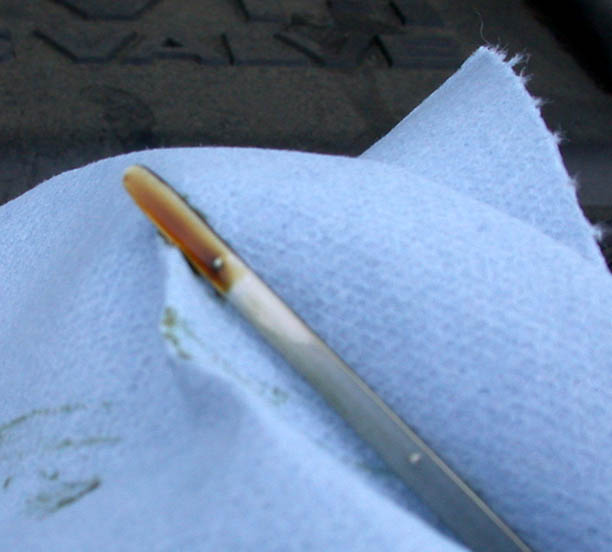
The method is the same in all three sources. Pull the dipstick out, wipe it clean, push it all the way back in, pull it out again and look where the oil film stops against the marks near the tip: a minimum and a maximum on the sticks the AA and National Highways describe, and on Ford's Maverick a middle "Nominal" mark as well. Ford adds a detail most people miss: "Read both sides of the dipstick and use the lowest oil level as the correct reading."3

When to add, and how much
This is where the sources give different rules, and it is worth seeing them side by side, because the difference is the whole point of the handbook.
- Ford, for the Maverick: "If the oil level is between the maximum and minimum marks, the oil level is acceptable. Do not add oil." And: "If the oil level is at the minimum mark, immediately add oil."3
- National Highways, for any car: if the oil is below the minimum mark, "you need to top up your oil level."5
- The AA, a motoring organisation that sells breakdown cover and repairs, for any car: "If the top of the oil streak is between the minimum and maximum marks, the level is fine. If the level is below halfway between the marks, then we would recommend adding some oil."2
So a stick reading a little under halfway gets two answers. Ford says it's acceptable and to add nothing; the AA also calls it fine but would add some. Neither is wrong for what it covers: Ford's is the maker's instruction for its own engine, the AA's a motoring organisation's general advice. For a Maverick, Ford's governs. For your car, your handbook's governs. If your handbook says nothing, the two general pages differ as well, National Highways topping up below the minimum mark and the AA below halfway, and this course doesn't pick between them.
How much? The AA says "The difference between the minimum and maximum notches on a dipstick is about a litre of oil", and it's careful about the other direction: "Putting too much oil into your car is just as bad as having too little."2 Ford: "Oil levels above the maximum mark may cause engine damage."3 That is why a top-up goes in a little at a time, with a wait and a re-check between.
Now a case with the numbers in it. A dipstick on a car whose handbook says nothing about when to add shows the oil a third of the way up from the minimum mark.
On the AA's advice, should oil go in, and roughly how much would take it to the top? What happens if the owner just pours in a litre?
Show the answer
Yes, some: a third of the way up is below halfway, so the AA (which sells breakdown cover and repairs) "would recommend adding some oil". On the AA's figure of about a litre between the marks, about two thirds of a litre would take it to the top mark; that's this course's arithmetic on the AA's round number, and your engine's gap may differ. Pour in a whole litre and the level ends up about a third of a litre above the maximum mark, which the AA calls "just as bad" as too little and Ford says may damage an engine. Add a little, wait a couple of minutes, read again.
The rest of the rules for adding oil come from the same pages. Ford: "Do not add engine oil when the engine is hot."3 The grade matters. The AA: "It's important to use oil that meets the right technical specifications", and "It also needs to be the right grade (the numbers separated by a 'w', such as 5w30)."2 Those come from your handbook, not from a shelf at a filling station. Lesson 3, "Diesel exhaust: the DPF and AdBlue", showed one reason the grade is not a matter of taste on a diesel with a particulate filter. And nothing else goes in with it. Ford: "Do not use supplemental engine oil additives because they are unnecessary and could lead to engine damage that the vehicle warranty may not cover."3
What the oil itself tells you
Colour first. The AA: "New oil is clean and golden in colour, but quickly turns dark brown or black when it's in use. This darkening is quite normal and is nothing to worry about."2 The same page adds the exception: "However, if it's black and the texture is sludgy, it'll need replacing."2 Dark oil isn't a reason to add any; black, sludgy oil is a reason to book the oil change, which is garage work in this course.
Milky oil is different. The AA: "Oil with a milky, creamy or foamy appearance means coolant or water is leaking into the oil. You'll need to get this checked by a mechanic."2
Then the level over weeks. National Highways: "Take your car back to the garage if you're topping up more than usual."5 The surprise is a level that rises. Ford says it can happen: "Increases in oil level can occur from frequent short trips that do not allow the engine to get to operating temperature, as well as frequent idling or low speed driving for long periods of time." And: "If oil levels are continuously noted above the maximum mark, have your vehicle checked as soon as possible."3 Ford gives the causes and no mechanism; this course read none.
In the course's labels, then:
- Yours: reading the dipstick, or the dashboard oil display, by the handbook's method.
- Yours, on conditions: adding oil. The conditions are the handbook's grade, level ground, an engine that is off and not hot, a little at a time, and never past the maximum mark.
- Call someone: milky oil; black, sludgy oil; a level you're topping up more often than usual; a level that keeps rising.
Changing the oil is garage work, and this course doesn't teach it.
Coolant
Why a hot cap is never opened
The Met Office's winter checklist, which reproduces one from the RAC, a motoring organisation that sells breakdown cover and repairs, says what coolant is for: "Coolant (a mixture of water and antifreeze) is pumped around your engine to cool it."6 An electric car has it too: the LEAF has a coolant reservoir, and AFDC says some battery systems use liquid coolant, as lesson 4 showed.
The danger is in two sentences from the handbooks. Nissan: "The coolant reservoir is equipped with a pressure type coolant reservoir cap." And, for the LEAF: "Never remove the coolant reservoir cap when the motor compartment is hot. Serious burns could be caused by high-pressure fluid escaping from the radiator."4 Ford, for the Maverick: "Coolant expands when it is hot. The level may extend beyond the MAX mark." When Ford describes topping up a cooled system, its first step still says: "Unscrew the cap slowly. Any pressure escapes as you unscrew the cap."3
Put those lines together, and this is this course's reading rather than any one source's sentence: hot, the coolant has expanded, and the system holds it under pressure behind Nissan's "pressure type" cap. Take the cap off and that pressure has somewhere to go, and Nissan's warning is that it takes hot fluid with it. Neither handbook explains the physics further; the technicians' textbook in Go deeper is where to look.
Ford's handbook tells Maverick owners to wait 10 minutes and cover the cap with a thick cloth. Nissan's tells LEAF owners to wait until the motor compartment cools down. Before reading on: which should you follow on your own car, and what would you do if your handbook gave no wait at all?
Show the answer
Your own handbook's. Each wait is that maker's for its own car, and neither handbook says why it chose its wording, so this course doesn't guess. Where your handbook gives no time, this course's rule is stricter than either: wait until the engine or motor compartment is cold. Nothing in the sources says a longer wait is ever less safe.
Here are the waits side by side.
| Source | For which car | The wait before opening |
|---|---|---|
| Ford, 2024 Maverick handbook (US and Canada) | That truck | "Wait 10 minutes for the cooling system to cool down", then a thick cloth over the cap and open it slowly |
| Nissan, 2024 LEAF handbook (US) | That car | "Wait until the motor compartment cools down" |
| The RAC's list, as the Met Office page reproduces it (the RAC sells breakdown cover and repairs) | Any car, advice | "Remember only check this when the engine is cool otherwise you risk scalding yourself." |
| The Highway Code, Annex 6 (Great Britain) | Any car that has overheated, advice | "If your engine overheats, you should wait until it has cooled naturally. Only then remove the coolant filler cap and add water or other coolant." |
Sources: Ford p. 309; Nissan pp. 8-5 and 8-6; the Met Office page; Annex 6.3461
Two things about that table. Annex 6's sentence is about an engine that has overheated, not an ordinary drive, and it is advice, a should. And "cold" is this course's rule, not any one source's: it is stricter than Ford's ten minutes, and it is the one that works on a car whose handbook you haven't got to hand.
Reading it, and topping it up
You read coolant the same way as brake fluid: through the side of a see-through reservoir, against a MIN and a MAX mark, with the cap shut. Ford: "When the engine is cold, check the concentration and level of the coolant", and the level should be between the marks (the concentration, Ford says, is measured with a refractometer, a tool this course leaves to a garage). Nissan, for an electric car: "Check the coolant level in the reservoir when the high-voltage parts are cold."34 Reading it is Yours.
Topping it up is Yours, on conditions: only when cold, only the coolant the handbook specifies, and only to the MAX mark. The coolant matters more than people expect. Ford says "Do not mix different colors or types of coolant in your vehicle", and specifies a pre-diluted coolant; Nissan specifies its own blue coolant or an equivalent, and says additives like radiator sealer may damage the motor and its electronics.34 Ford does allow one exception, for an emergency: plain water to reach a garage, followed by a service as soon as possible, because it says water alone can damage an engine.3 Annex 6's "add water or other coolant" after an overheat is the same idea in more general words.
A level that falls
Coolant isn't supposed to be used up the way oil is. The RAC's checklist, as the Met Office page reproduces it: "It's not normal for coolant levels to drop suddenly, so if it does, get it checked out at a garage."6 Ford puts a number on it for the Maverick: "If you have to add more than 1.1 qt (1 L) of engine coolant per month, have your vehicle checked as soon as possible." Nissan, for the LEAF: "If the cooling system frequently requires coolant, it is recommended that you visit a NISSAN certified LEAF dealer."34 Ford's litre a month is Ford's, for the Maverick. The pattern in all three is the one to keep: a level that drops, or one you keep having to make up, is Call someone.
What about the temperature warning light? A top-up is a common first answer to it, and it is the wrong first move. Lesson 11, "Dashboard warning lights", takes the light itself; lesson 16, "When the car stops: where, who stands where, and the call", covers where to stop. What this lesson adds is the order: stop safely, switch off, and only once the engine is cold does anyone look at the coolant.
Brake fluid, in the routine
Lesson 6, "Brakes, steering and suspension", explained what brake fluid does, why it's changed on a schedule, and why a level that keeps falling is a matter for a garage. This lesson makes the reading part of your weekly look.
Ford's method, for the Maverick: park on a level surface, then "Look at the brake fluid reservoir to see where the brake fluid level is relative to the MIN and the MAX marks on the reservoir."3 Nissan's LEAF maintenance checklist says the same in its own words, and its brake-warning-light page says what a low reading means for that car: "If the brake fluid level is below the minimum or MIN mark on the brake fluid reservoir, do not drive until the brake system has been checked."4 That's Nissan's instruction for the LEAF. Lesson 6 showed Toyota's handbook saying something close for the Corolla.
The cap stays on. As lesson 6 set out, reading the level through the side is Yours, and in this course's labels anything on the brakes beyond reading the level is Call someone, including adding fluid, which some handbooks do describe.
Three weekly readings, on three different cars. Car A's brake fluid sits a little below MAX, the same as last week. Car B's coolant, read cold, is between the marks but lower than last month, and the owner has added some twice. Car C's brake fluid is below MIN. Which label fits each, and what happens next?
Show the answer
Car A: Yours, and nothing happens except a line in the log; a level between the marks that isn't moving calls for nothing, and Toyota's handbook, in lesson 6, calls even a slight fall as the pads wear normal. Car B: Call someone; Ford and Nissan send a coolant level you keep having to make up to a garage, and the RAC's checklist (on the Met Office page; the RAC sells breakdown cover and repairs) a sudden drop. Car C: Call someone, and on Nissan's handbook for its own car, don't drive it until the brakes have been checked; your handbook's words for your car come first, and lesson 11 covers the red brake light, which Nissan's handbook ties to a low fluid level.
Screenwash, and the law on washers
This is general information, not legal advice.
What goes in
Screenwash is the one fluid in this lesson you can simply top up. National Highways says the reservoir "can be filled to the top" and to follow the mixing instructions on the bottle.5 The filler usually has a bright cap with a windscreen symbol on it; the engine-bay picture in your handbook shows yours. Topping it up is Yours.
What you put in depends on the weather, and here two handbooks and one checklist agree in outline and differ in the numbers.
- Ford, for the Maverick: "If you operate your vehicle in temperatures below 41°F (5°C), use washer fluid with antifreeze protection."3
- Nissan, for the LEAF: "In the winter season, add a windshield-washer antifreeze", pre-mixed with water to its maker's instructions before it goes in, not mixed inside the reservoir.4
- The RAC, which sells breakdown cover and repairs, in the winter checklist the Met Office (the UK's weather service) reproduces on its page: "Make sure you top up your screenwash with a product that is effective down to at least -15 degrees Celsius."6
One thing never goes in. Ford: "Do not put coolant in the windshield washer reservoir. If sprayed on the windshield, coolant could make it difficult to see through the windshield." Nissan: "Do not substitute antifreeze coolant for windshield-washer solution. This may result in damage to the paint."34 Two makers, two different reasons, one rule.
And don't run the pump on an empty bottle. Ford: "Do not operate the washers when the washer reservoir is empty. This could cause the washer pump to overheat."3
A Maverick kept outside in Montpelier shows the handbook doing the work. Its owner fills the washer bottle with plain water in October because it's cheap. On Ford's handbook for that truck, any temperature below 41 °F (5 °C) calls for washer fluid with antifreeze protection, and Ford gives the reason: "Failure to use washer fluid with antifreeze protection in cold weather could result in impaired windshield vision and increase the risk of injury or accident."3 How cold it gets where the truck is kept is the forecast's business, not this course's. What the handbook settles is that the winter fluid, mixed as its maker says, goes in before the first frost rather than after it.
What the law says, in Great Britain
In Great Britain, the Road Vehicles (Construction and Use) Regulations 1986 require a car with a windscreen to have "one or more efficient automatic windscreen wipers" (powered wipers, in the 1986 wording), unless the driver can see ahead without looking through the windscreen, and, with a few exceptions such as very slow vehicles, a washer that can clear the swept area "of mud or similar deposit" with the wipers. Then regulation 34(6) says: "Every wiper and washer fitted in accordance with this regulation shall at all times while a vehicle is being used on a road be maintained in efficient working order and be properly adjusted."7 "At all times" is the phrase that matters, and nothing in the regulation limits it to rain.
The MOT, Great Britain's periodic test, checks the same thing. DVSA's inspection manual says "Washers must provide enough fluid for the wipers to clear the windscreen effectively", and lists "Windscreen washers not working or not providing sufficient fluid to clear the windscreen" as a Major defect, which fails the test.8 Lesson 21, "The MOT and Northern Ireland's vehicle test", covers the whole test, and lesson 20, "The law on a car's condition: Great Britain and Northern Ireland", what can follow from breaking a rule like this one.
Northern Ireland has its own road traffic rules, which this course didn't read. In the US, what a state requires of washers depends on the state: Pennsylvania's inspection list, for one, includes the windshield washer.9 Lesson 22, "The US: state inspections, emissions tests and tread law", covers the states this course read.
Two more things you may find
Power steering fluid. Some cars have a reservoir for it; many modern cars have electric power steering with no fluid to check, and your handbook says which yours is. Neither handbook read for this lesson has one: Nissan's calls the LEAF's system "electric power steering", and Ford's engine-bay picture for the Maverick shows no steering reservoir.43 Virginia's inspection, for cars that do have one, lists "Power steering fluid" among the levels checked.10 This course read no handbook for a car with the fluid, so it gives no method. If your car has the reservoir, your handbook's method is the one to follow.
AdBlue. On some diesels the AdBlue filler is under the bonnet; the AA, which sells breakdown cover and repairs, lists it as "either next to your fuel filler, in the boot or under the bonnet".11 Lesson 3 covered it. Topping up AdBlue (DEF, in the US) is Yours, on conditions: from a sealed container, into the blue-capped AdBlue tank only, as your handbook describes.
A drip under the car. Nissan's LEAF checklist says to look for "water or other fluid leaks after the vehicle has been parked for a while", and adds: "Water dripping from the air conditioner after use is normal."4 You check that by looking at the ground where the car has stood, not by getting under it. Nissan's advice for anything else is "check for cause and have it corrected immediately"; for an owner, that's Call someone, with a note of where under the car the drip was and what colour it is.
What people get wrong
"The temperature light's on, so top up the coolant." Not first. Stop somewhere safe and switch off; the cap stays shut until the engine is cold, because the system is under pressure while it's hot (Nissan, Ford).34 Then read the level.
"More oil is safer." The AA, which sells breakdown cover and repairs, calls too much "just as bad as having too little", and Ford says above the maximum mark "may cause engine damage".23
"An additive will help the engine." Ford calls oil additives "unnecessary" and says they "could lead to engine damage"; Nissan says no additives in its coolant either.34
"Every car has a dipstick." Some newer cars show the oil level on the dashboard instead (National Highways; the AA, which sells breakdown cover and repairs), and an electric car has no engine oil.52
"A falling brake-fluid level just needs topping up." Topping up hides a fault; lesson 6 set out why, and in this course it is Call someone.
"Coolant in the washer bottle will stop it freezing." Two handbooks say never: it smears the glass (Ford) or damages paint (Nissan).34
Practice
Take 15 minutes over this. Use your own car, or one whose keeper agrees. You'll be reading the handbook, looking, topping up screenwash and, only if your handbook says so at the level you find, adding oil. Nothing more. Don't open the coolant cap, the brake-fluid reservoir or anything else under the bonnet for this exercise, except the screenwash cap and, if you need to add oil, the oil filler. Don't reach past, touch or go near anything orange, blue on a mild hybrid, or labelled high voltage. Keep your hands away from the fan; if the dipstick, the screenwash filler or the oil filler sits next to it and your handbook says to disconnect the battery before working there, leave that job as Call someone. Don't get under the car, and don't drive it for the exercise. If anything below looks wrong, stop, write it down, and treat it as Call someone.
- Prepare. Level ground, parking brake on, P or in gear. Switch the car off as the handbook describes (READY is not off), take the key or fob away from the car, and wait until it's cold: first thing in the morning is easiest. Glasses on, rings and watch off. Open the bonnet by the handbook's method.
- Map it. With the handbook's engine-bay picture in your hand, find each thing by looking: the dipstick (or write "dashboard display" or "no engine oil"), the coolant reservoir, the brake-fluid reservoir and the washer filler.
- Oil. Read the dipstick by the handbook's method, both sides, and write where the level sits between the marks and the colour of the oil. Add oil only if your handbook says to at that level, and only the handbook's grade, a little at a time, re-reading after each, and never past the maximum mark. If the handbook gives a wait and it hasn't passed, wait.
- Coolant and brake fluid. Read each level through the side of its reservoir, cap shut, against MIN and MAX. Write both down.
- Screenwash. Top it up with washer fluid suited to the season, mixed as its maker says.
- Log it. Date, mileage, and the four readings, in your car file's checks log.
Check your log against these. When does a reading in steps 3 and 4 mean you stop being the one who deals with it?
Show the answer
Milky oil, black and sludgy oil, an oil level that keeps rising, or oil you're adding more often than usual: Call someone (the AA, which sells breakdown cover and repairs; National Highways; Ford). Coolant below MIN on a cold engine is Yours, on conditions, as a separate job after this exercise, not during it: the handbook's coolant, cold, and only to MAX. Coolant you keep having to add is Call someone. Brake fluid below MIN, or a level that keeps falling from week to week: Call someone, and on Nissan's handbook for the LEAF a level below MIN means don't drive it until it's checked. A slight fall as the pads wear is what Toyota's handbook calls normal (lesson 6). A dark dipstick at a good level, or a steady brake-fluid level a little under MAX, is just a line in the log.
For your plan
This lesson adds a checks log to your car file: date, mileage, oil, coolant, brake fluid and screenwash, with a line for anything you noticed. Beside it, from your handbook: how your car reports its oil level, the oil grade and the coolant type, the handbook's wait before checking oil, your washer fluid for winter, and the handbook's own page references for each. The Highway Code's advice is weekly; whatever you choose, write it down, so the log shows a change when one comes.
Connections
Lesson 2, "The engine: petrol, diesel, and the drive to the wheels", gave the reasons behind the oil and coolant checks; lesson 4, "Hybrids and electric cars: how they work", the reason a silent car isn't an off car; lesson 6, "Brakes, steering and suspension", the brake-fluid reservoir. Lesson 10, "Lights, wipers, glass and the walk-round", finishes the owner's routine outside the car. Lesson 11, "Dashboard warning lights", takes the oil, temperature and brake lights. Lesson 15, "Winter and summer", comes back to antifreeze in the coolant and the washer bottle.
Go deeper
- Your own handbook, the maintenance or "do-it-yourself" chapter and its engine-bay picture. Every source in this lesson sends you there first, and it's the only one with your car's grades and waits.
- National Highways, "How to check your vehicle", free. Read here in full. A short official checklist for England's roads, covering tyres, fuel, oil, screenwash and lights.
- The AA, "How to check and top up your car engine oil", free; a motoring organisation that sells breakdown cover and repairs. Read here in full. Covers the dipstick, the colour of oil and what low oil does.
- Halderman and Ward, Automotive Technology: Principles, Diagnosis, and Service, 7th edition (Pearson), a technicians' textbook. This course read only its table of contents, which lists chapters called "Engine Oil and Filters" and "Antifreeze and Coolant"; those are the places to look for the mechanisms this lesson stops short of.
Sources
- The Highway Code (Department for Transport and DVSA), "Annex 6. Vehicle maintenance, safety and security", updated 29 January 2022. Great Britain. Read: full text, re-read 26 September 2026 through the GOV.UK content API. The lines used here are advice, not MUST rules.
- The AA, "How to check and top up your car engine oil", updated 17 June 2024. A motoring organisation that sells breakdown cover and repairs; not official. Read: the full article text, re-read 26 September 2026. Its low-oil paragraph is used here for the first time in this course.
- Ford Motor Company, 2024 Maverick Owner's Manual, edition 202307, US and Canada, read from Internet Archive capture 20250505042038 (Ford's site refuses automated readers). Read for this lesson, 26 September 2026: printed pages 87 to 91 (wipers and washers), 193 (brake fluid), 303 to 307 (maintenance precautions, opening the hood, under-hood overviews) and 308 to 310 (oil and coolant), in full; and the warning boxes on pp. 170 (Auto-Start-Stop, petrol) and 184 (high-voltage battery precautions). A maker's handbook for its own truck, sold as petrol or hybrid.
- Nissan North America, 2024 LEAF Owner's Manual and Maintenance Information (US market), PDF. Read for this lesson, 26 September 2026: pp. 8-2 to 8-12 and 9-2 to 9-4 in full, and the lines cited on pp. 2-17 to 2-18 and 2-23. A maker's handbook for its own electric car.
- National Highways, "How to check your vehicle", undated. The government-owned company that runs England's motorways and major A-roads. Read: full text, re-read 26 September 2026.
- Met Office, "6 simple checks to prepare your vehicle for winter", undated. The UK's national weather service; the page reproduces the RAC's winter checklist. Read: full text, re-read 26 September 2026.
- The Road Vehicles (Construction and Use) Regulations 1986 (SI 1986/1078), regulation 34, as amended. England, Wales and Scotland. Read: the whole regulation on the live page, 26 September 2026.
- Driver and Vehicle Standards Agency, "MOT inspection manual: cars and passenger vehicles", section 3, "Visibility", section updated 29 November 2024, manual updated 1 June 2026. England, Scotland and Wales; written for testers. Read: section 3 in full, 26 September 2026. Major defects fail the test (the manual's Introduction, section 7).
- Pennsylvania Department of Transportation, "Safety Inspection Program Frequently Asked Questions for Consumers", undated. Read: the list of items inspected on passenger cars, re-read 26 September 2026.
- Virginia State Police, "Vehicle Safety Inspection", undated. Read: the web page in full, re-read 26 September 2026.
- The AA, "What is AdBlue?", published 5 January 2017, updated 11 July 2024. A motoring organisation, as above. Read: the full article text, re-read 26 September 2026.
Check your understanding
This lesson has a 5-question quiz. Pass it and the questions come back on a schedule in Review, so what you learned stays learned. Your progress is saved in your browser; no account needed.